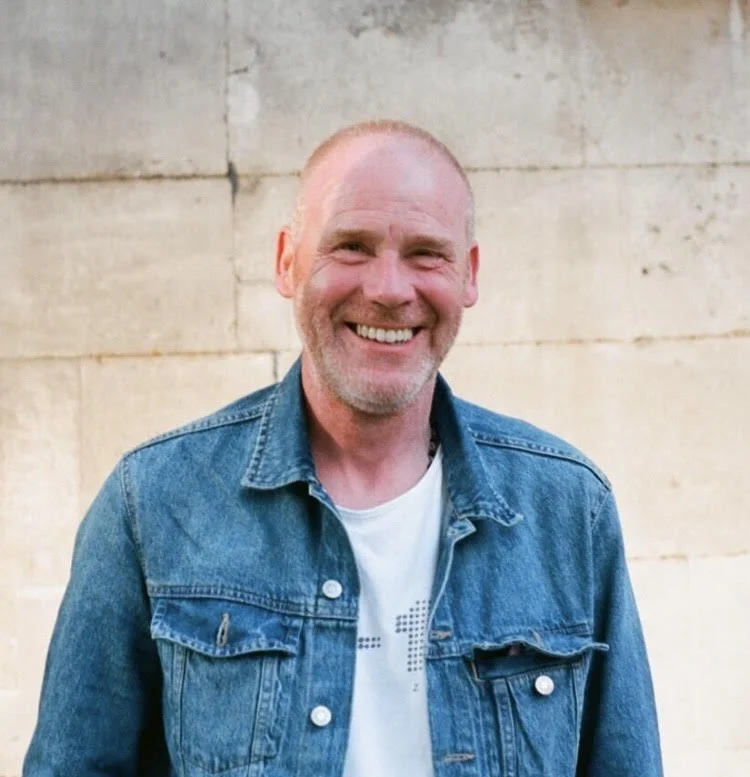
Making an impact with Genaro Rivas
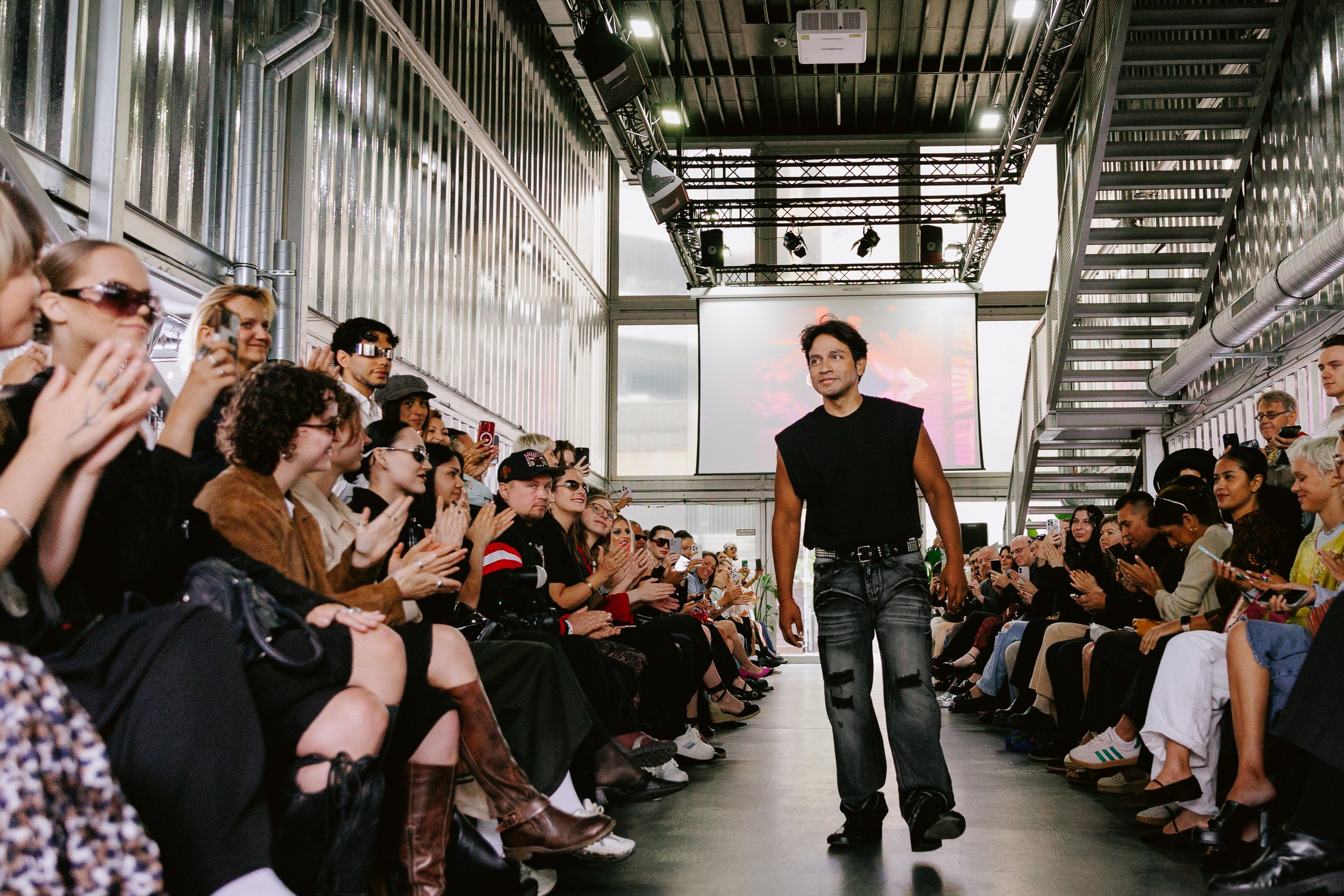
London-based Peruvian designer Genaro Rivas took his S/S 27 collection “State of Impact” to Berlin Fashion Week on the 4th July , the first stop in a three city project which also saw the collection showcased in London on the 29th July and finally at Copenhagen Fashion Week in early August.
It was an innovative and ambitious departure from the tried and tested fashion formula. A hugely impressive undertaking given the timescale and the considerable logistics involved in staging one show , let alone three in three different countries ! A schedule made even more impressive by the fact that "State of Impact” was presented in a slightly different format in each of these cities!
It’s indicative of the passion and energy that Genaro brings to his practice. A practice which explores the intersection where craftsmanship, material innovation and an ethical ethos are explored through a Latin American lens. These creative and cultural touchstones coalesce to form a distinctive , yet constantly evolving , design DNA. One where next-generation materials , recycled fabrics and organic fibres combine in the creation of pieces defined by their reconstructed silhouettes , disruptive tailoring and sheer imagination. A trifecta of texture, technique and tactility that’s underpinned by an environmental consciousness and a commitment to supporting artisans in Peru and London.
Avesso spoke to Genaro just before Copenhagen Fashion Week , the final stage in his fashion show trilogy, to ask about the influences that inspired “State of Impact” , the ethical values that underpin all he does and his future aspirations.
1/ Congratulations on your latest collection “State of Impact”. What message do you want that powerful title to convey and what type of impact do you want the collection to have on those who view it ?
“State of Impact” is about returning to the exact place where transformation begins: the moment of rupture. Not to relive the damage, but to reclaim the energy held within it and give it another form.
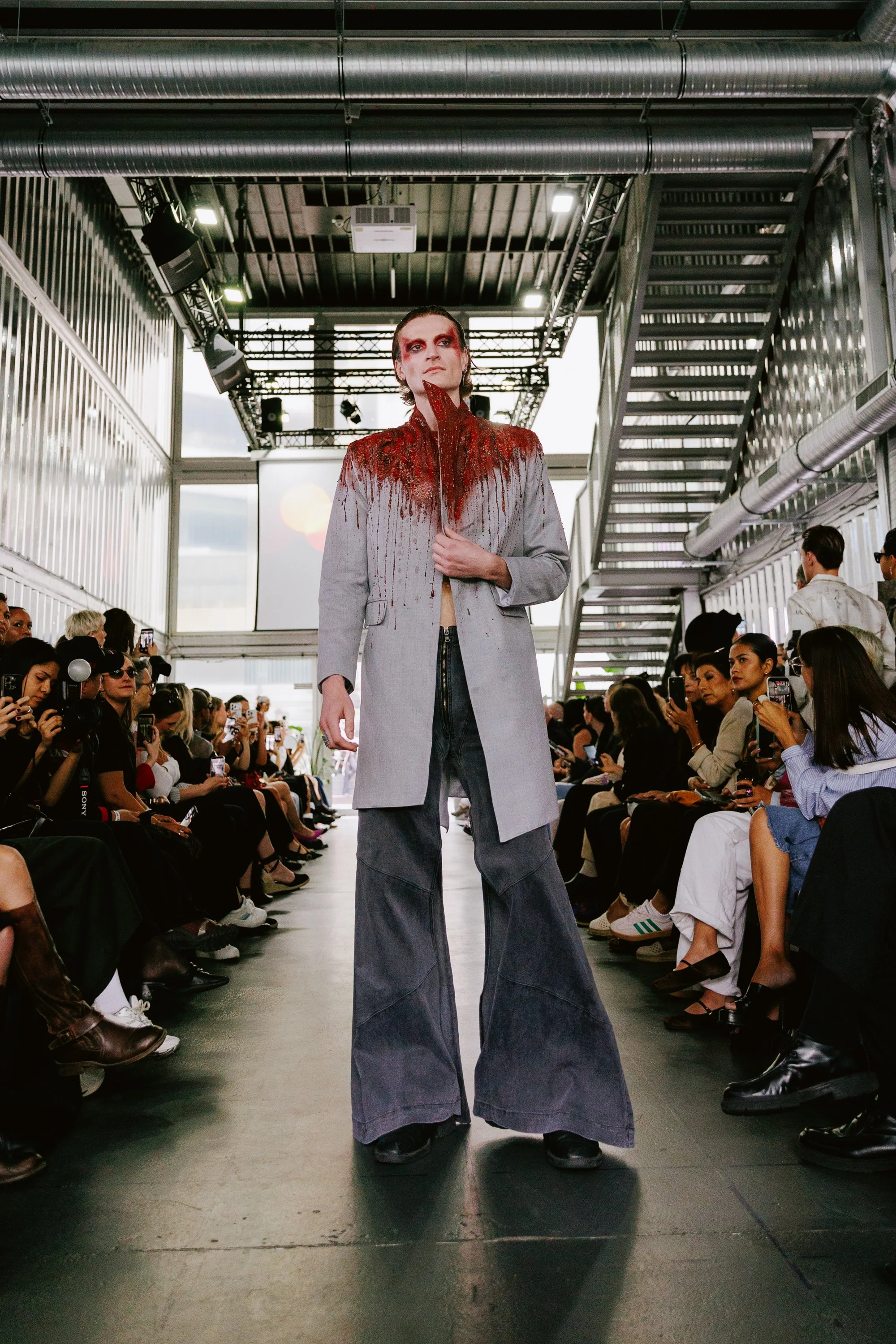
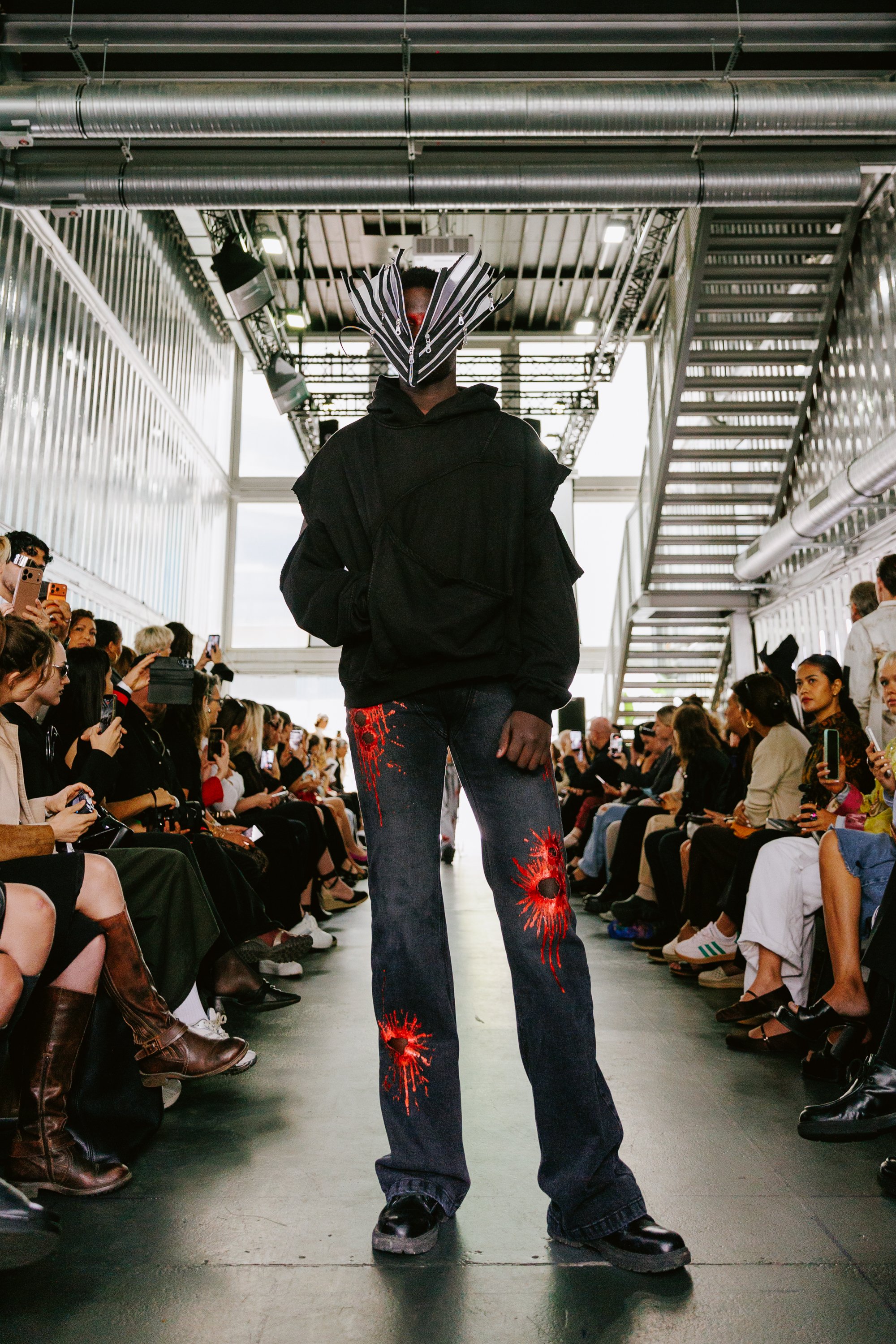
Throughout the collection, fragments and shards become something beautiful, protective and more powerful than what existed before. They still carry the memory of violence, but their purpose has changed. What once cut the body can now become its armour.
I want the collection to leave viewers with that tension: beauty and danger, fragility and strength, darkness and rebirth. I want it to feel almost ritualistic, as though they are witnessing the precise moment when destruction becomes creation. The impact I hope it has is not simply visual. I want people to recognise that transformation does not always mean erasing what happened; sometimes it means returning to the fracture and choosing what it will become.
2/ In what ways have Berlin and the work of German expressionist artist Walter Gramatté influenced the collection and how are those themes reflected in the pieces we saw on the runway ?
Berlin influenced the collection through its tension between destruction and reinvention. It is a city where history remains visible, visible in its architecture, its surfaces and its scars. Yet those traces have continually been transformed into new forms of culture, freedom and identity. That energy felt deeply connected to “State of Impact”: the idea that damage does not have to be concealed in order for transformation to occur.
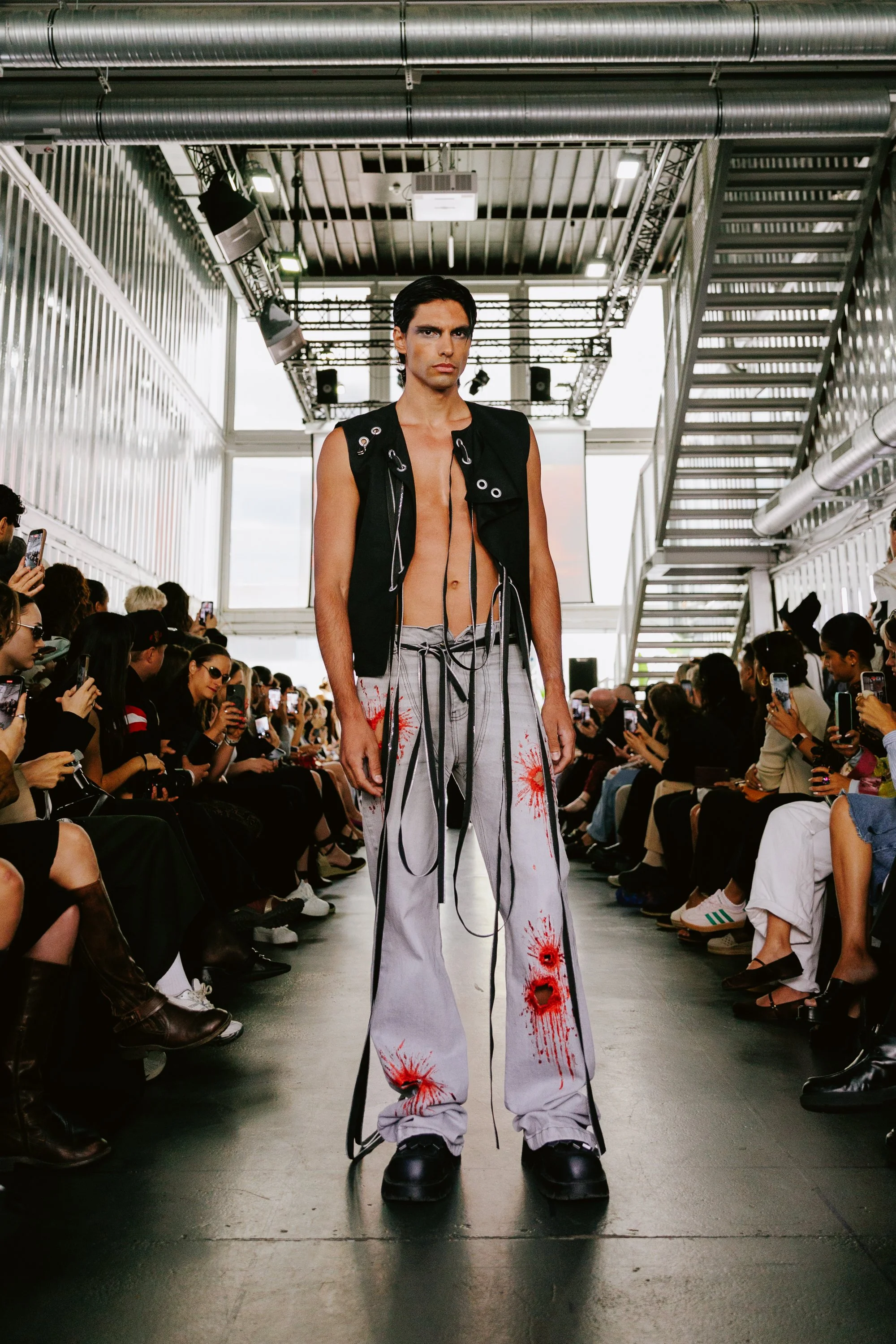
Walter Gramatté’s work introduced a more intimate and psychological dimension. I was particularly drawn to his 1918 portrait “Peter with a Gunshot Wound in His Forehead.” There is something unsettling yet incredibly powerful in the image: the body has experienced violence, but it remains present, confronting us. I was interested in that suspended moment when a wound is no longer simply an injury, but begins to alter the identity of the person carrying it.
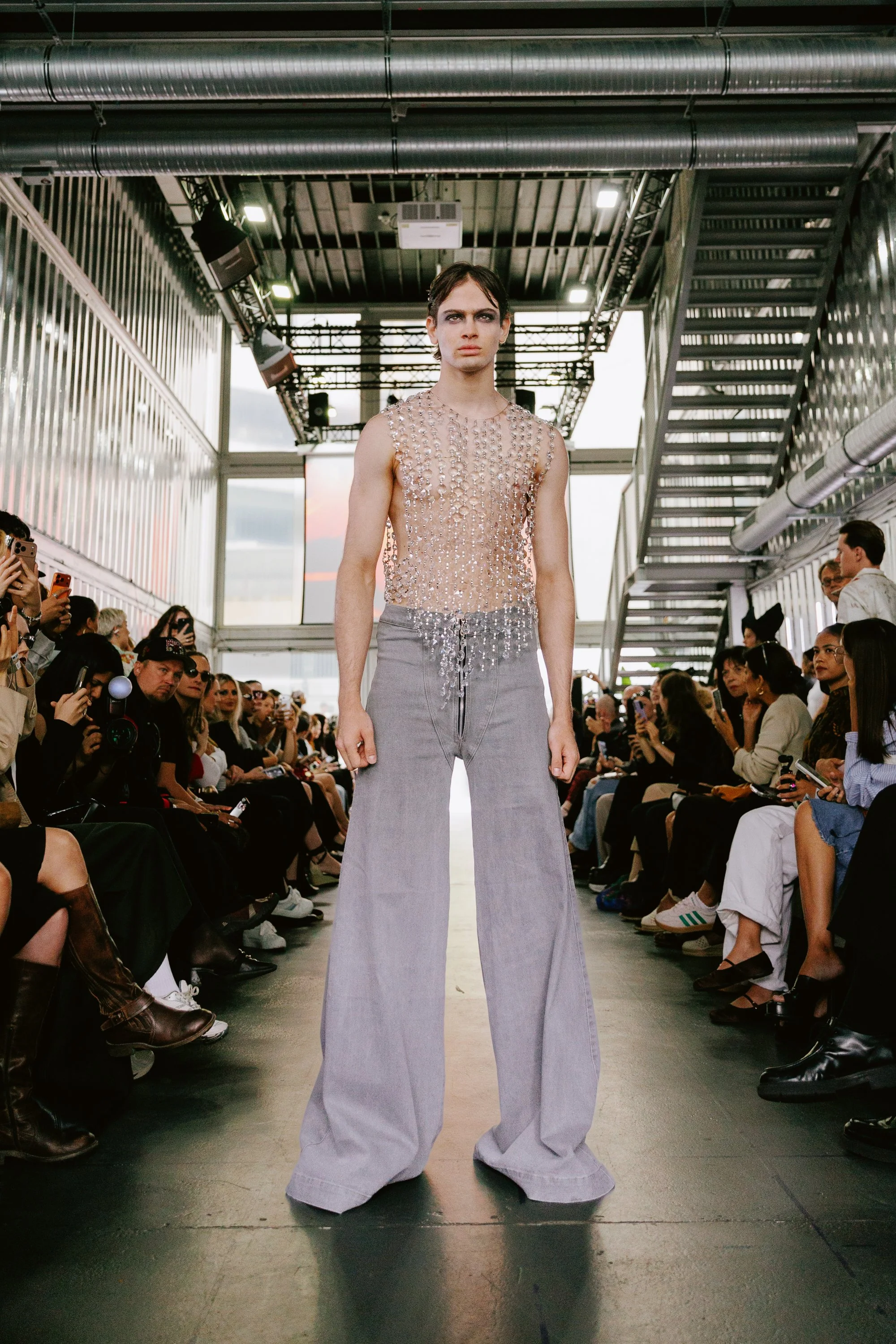
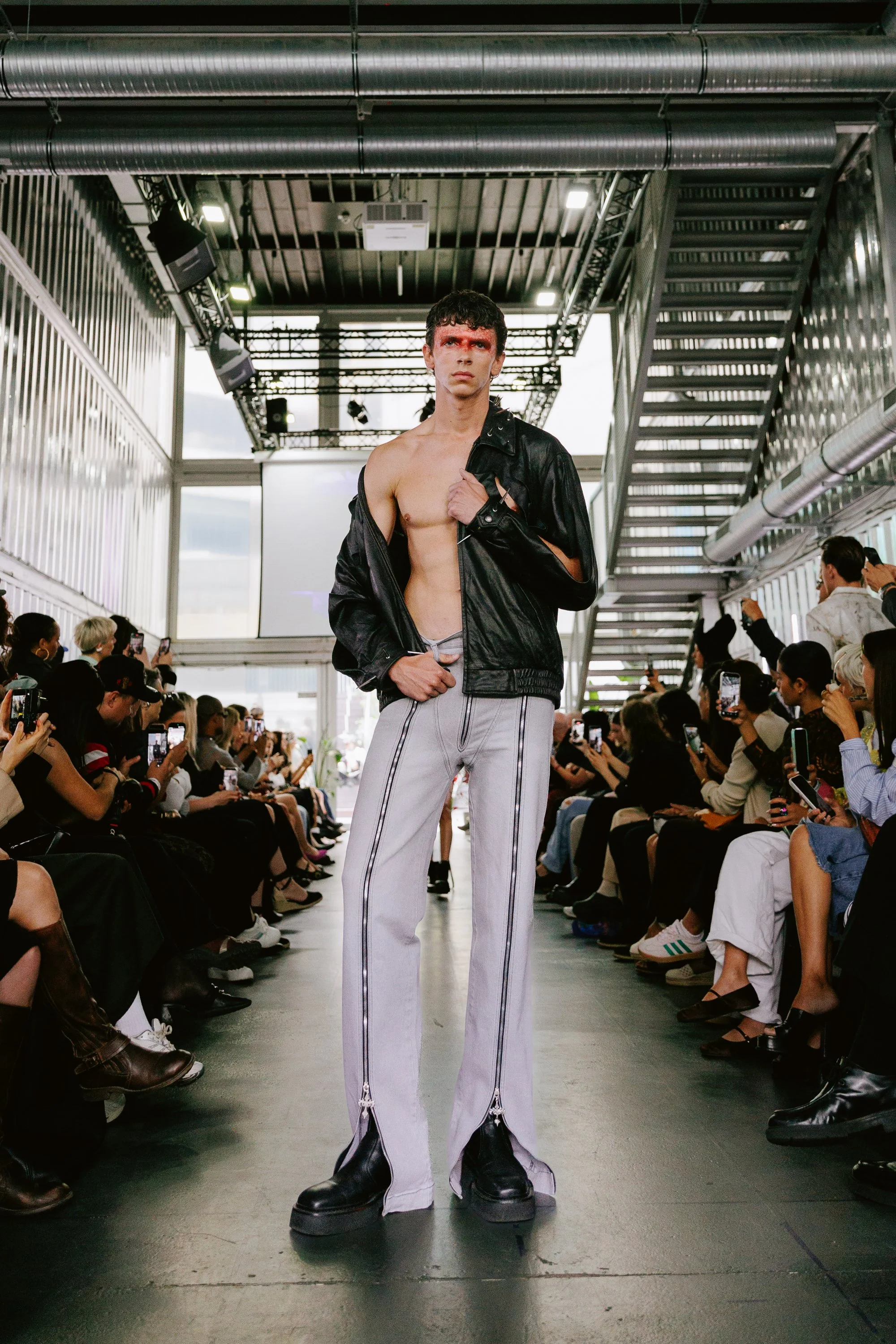
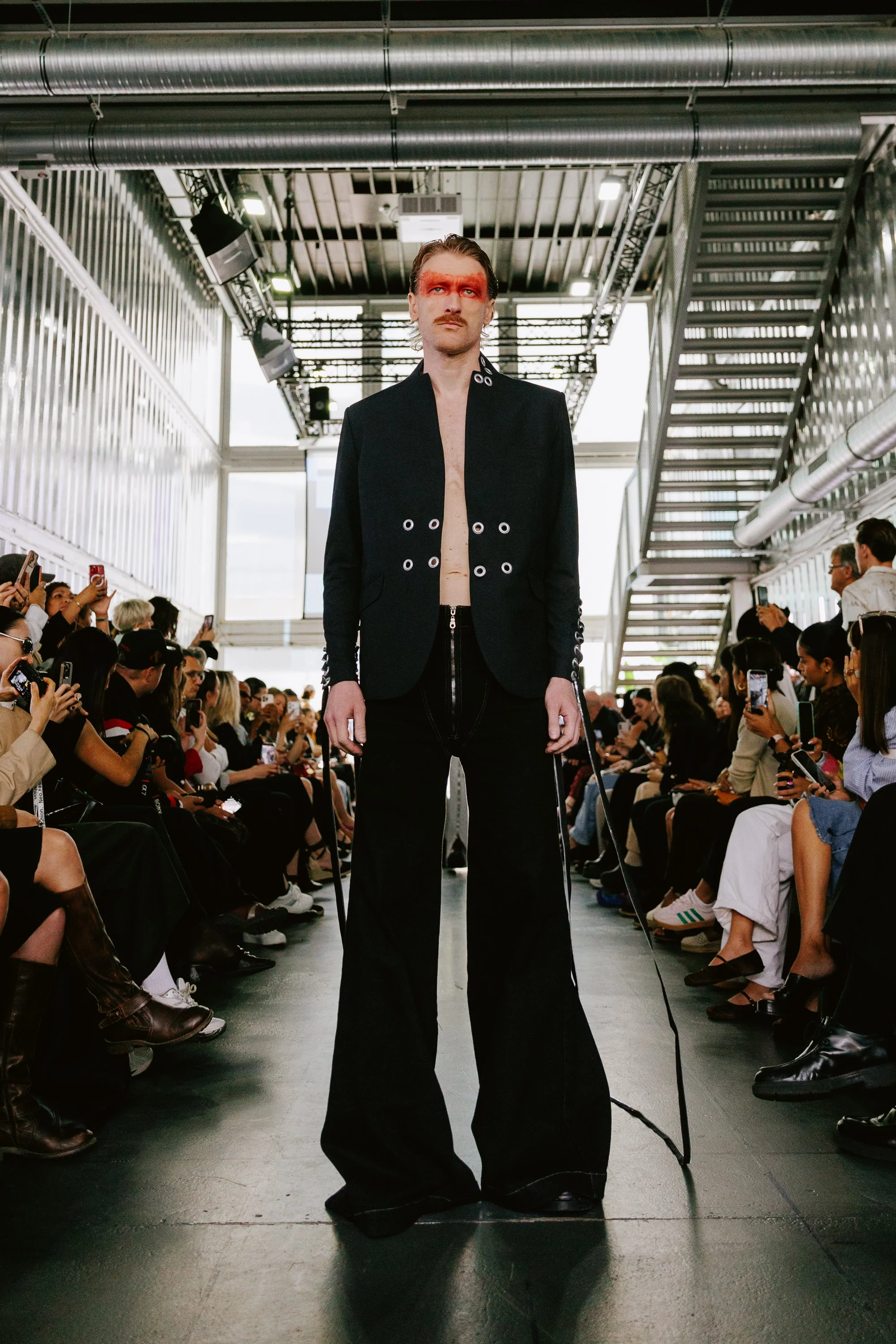
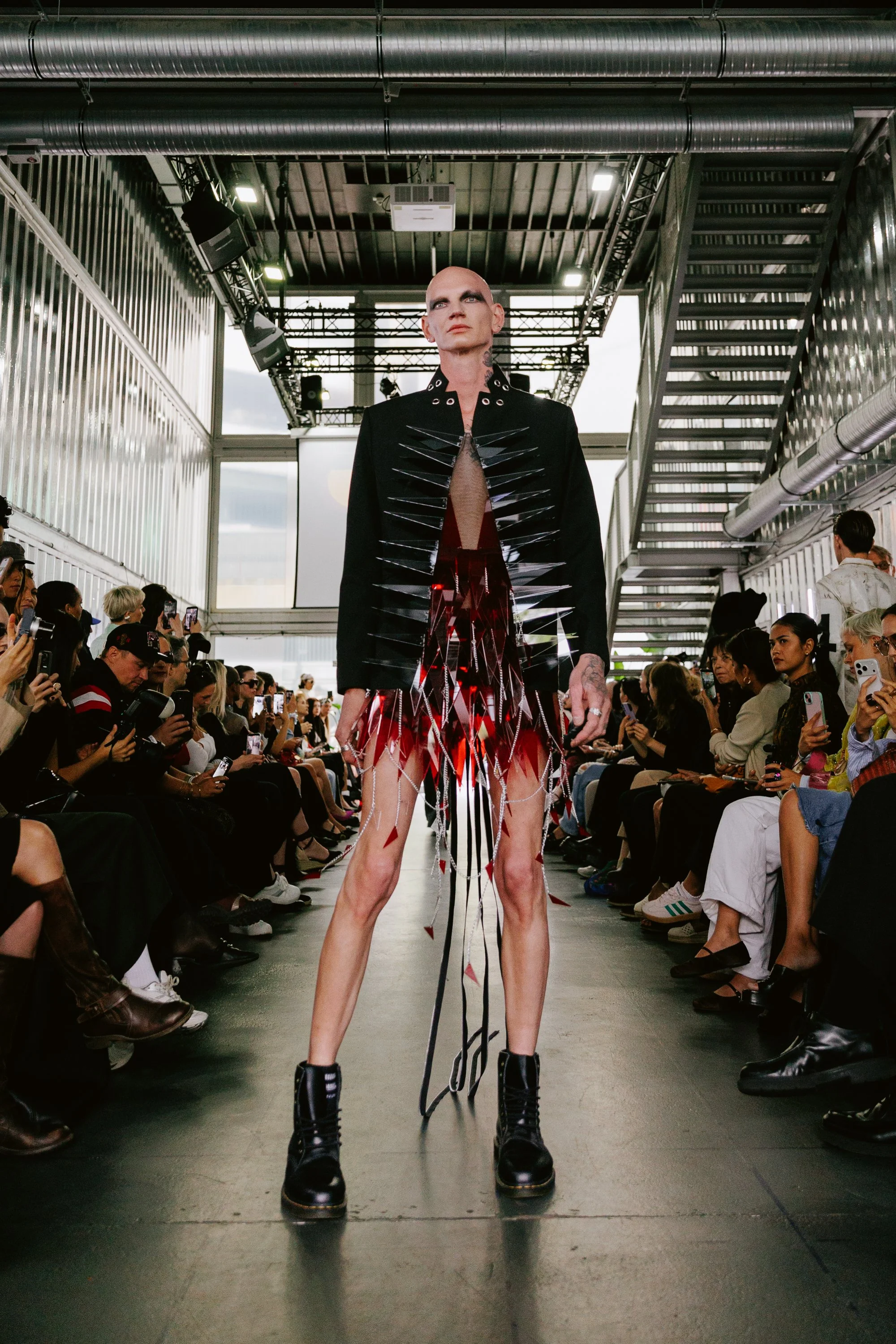
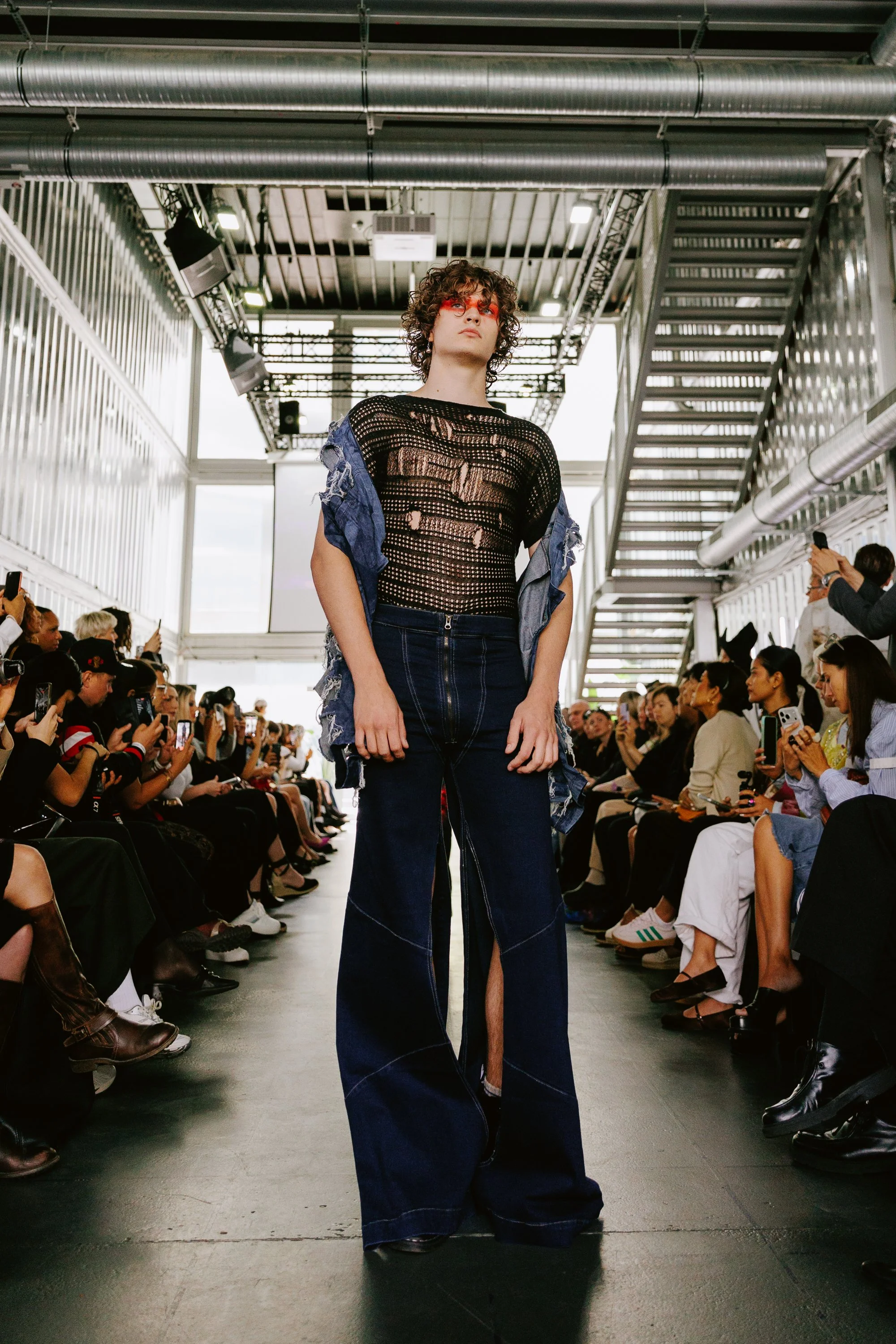
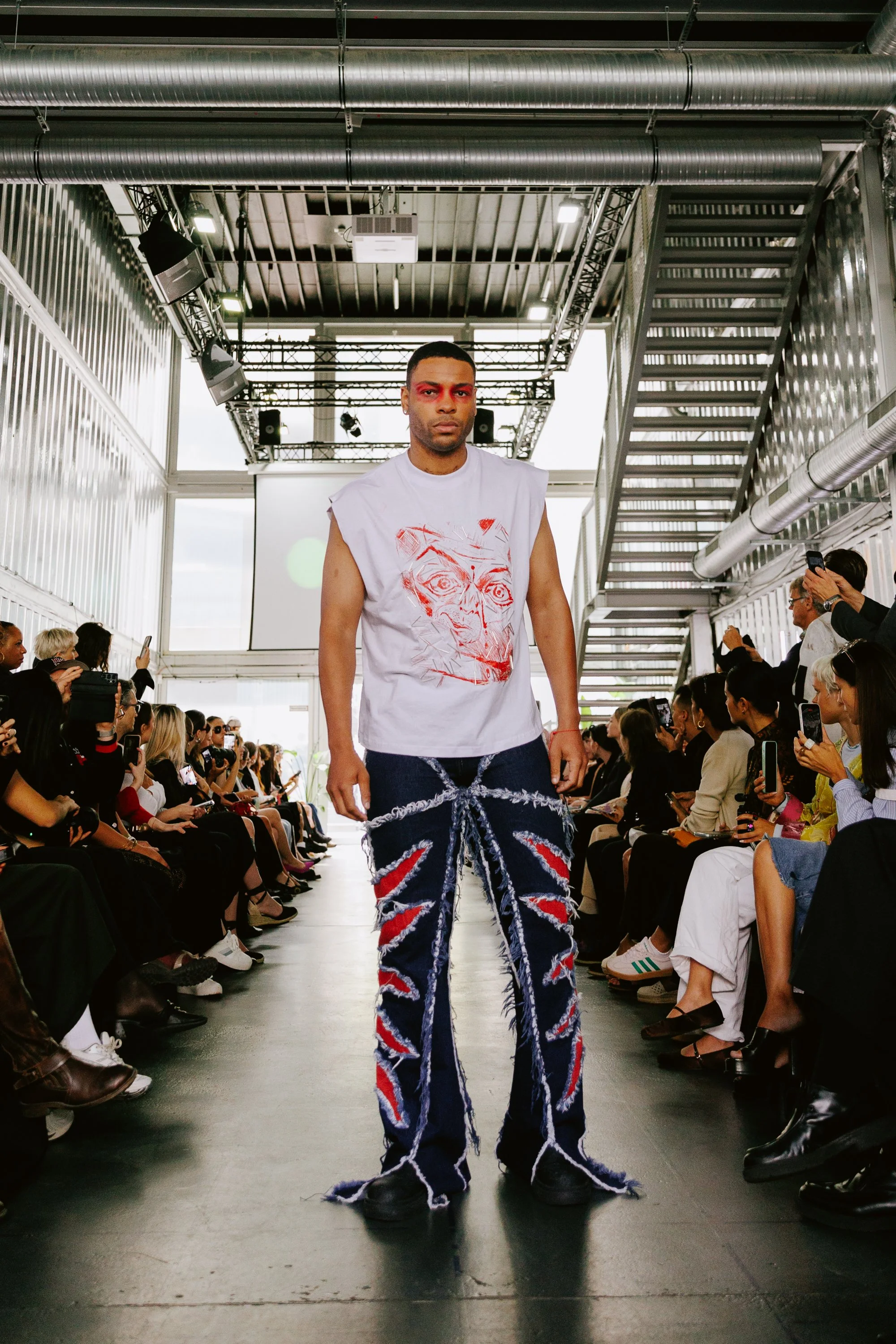
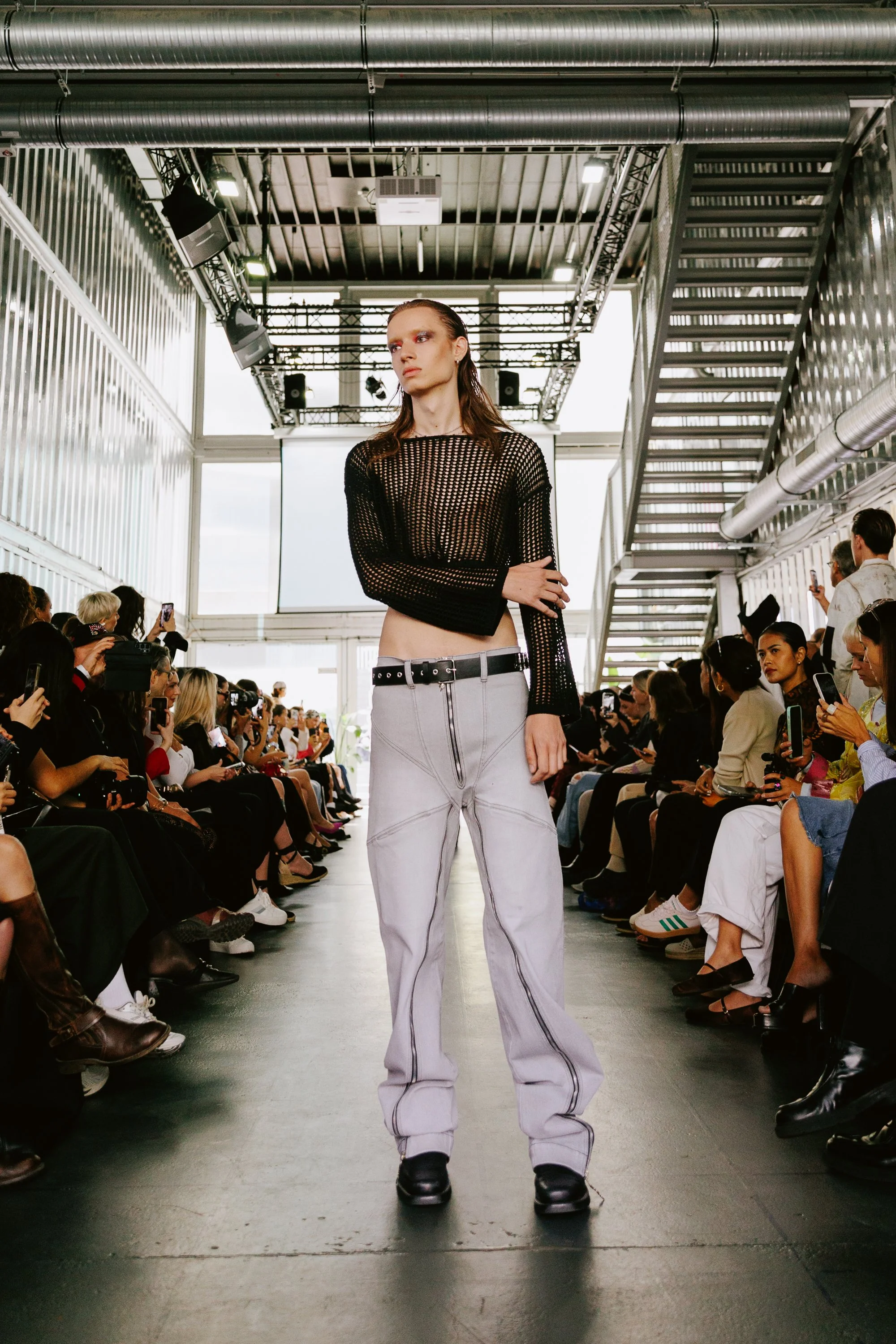
These ideas appear throughout the collection in distressed surfaces, fragmented tailoring, exposed construction and sharp, shard-like embellishments. Acrylic fragments and recovered crystals trace the body almost like evidence of an impact, while exaggerated proportions, layers and protective structures transform vulnerability into armour. Even the more delicate pieces contain a sense of danger as though they could fracture again at any moment.
I did not want to reproduce Gramatté’s work literally. I wanted to translate its psychological intensity, Berlin became the perfect place to reveal that transformation, because the city itself understands how scars can become part of a new language.
3/ Ethical and environmental values lie at the core of all you do. Can you tell us about the sustainable materials and practices you used in the creation of this collection?
For me, sustainability is not a layer added at the end of the creative process; it is part of the language of the collection from the very beginning. “State of Impact” is built around transformation, so the materials also needed to embody the possibility of becoming something else.
We worked with next-generation materials including Savian’s plant-based fur, Banofi’s banana-based leather, Ponda’s BioPuff® and fabrics developed with recycled plastic for Lemar, alongside low-impact denim and recovered leather. Each material carries a different vision of what fashion can become when we move away from extractive systems and begin to design with greater responsibility.
Waste reduction was equally important. Several pieces were developed through zero-waste or low-waste cutting, and fragments left from the construction process were reincorporated as embellishment, texture or structure.
The clearest expression of this appears in the final look, created with crystals recovered from discarded chandeliers. We dismantled them and brought them directly onto the body, transforming them into something almost ceremonial. The fragments are not disguised or restored to their original state. Their previous life remains visible,
I am less interested in making discarded materials appear new than in revealing the power of their transformation. Sustainability, for me, is a form of alchemy, taking what has been overlooked, broken or abandoned and allowing it to return with a different purpose.
4/ An extension of that ethical ethos is your circular hub. How does that work and how important is it , to not only design sustainably , but to also preserve your creations' longevity ?
The Circular Hub was conceived around a simple belief: the life of a garment should not end when its first owner no longer wears it. It is a space dedicated to resale, repair and rewear, allowing existing Genaro Rivas and La Nacional pieces to return, be restored, altered or passed on to someone new.
Longevity begins with the way we design. I want the pieces to feel collectible rather than disposable, to have enough identity, quality and emotional weight to remain relevant beyond a single season. But durability alone is not enough. We also need systems that support the garment after it leaves our hands, whether through repair, mending, adaptation or resale.
The Hub allows us to preserve not only the physical object, but also the labour, materials and human stories held within it. For me, circularity is almost an act of resistance against disappearance.
Designing sustainably is essential, but preserving a creation’s longevity is what allows its purpose to continue moving through different bodies, lives and moments in time.
5/ While A/W 26's “A Glass to Break” was predominantly womenswear, your S/S 27 collection focuses on menswear. Was it a conscious decision to return to menswear and what were the reasons behind that ?
It was a conscious decision, although I do not see it as leaving womenswear behind. I was interested in shifting the body through which the story was being told. Also, I like to separate my seasons and collections, creating new collections and telling stories is part of my DNA.
“A Glass to Break” explored fracture through a predominantly feminine silhouette, while “State of Impact” asks what happens when that same language of vulnerability, damage and protection is placed onto the masculine body. Menswear is often expected to communicate control, hardness and certainty. I wanted to disturb that expectation and reveal something more exposed beneath it.
The collection allowed me to explore masculinity as a state that can also fracture, transform and rebuild itself. Sharp tailoring is interrupted, proportions become exaggerated, surfaces are opened or distressed, and delicate crystals and shards sit against more protective structures. There is a constant tension between armour and fragility.
At the same time, I do not design with rigid ideas of gender. Many of the pieces can move between bodies, and that ambiguity is important to me. Returning to menswear also allowed me to question what strength looks like. Sometimes strength is not remaining intact. Sometimes it is allowing the fracture to become visible and choosing what form it takes next.
6/ Much of your work also strikes us as genderless. Is this something that you intentionally look to achieve and , if so , how liberating is that freedom to design without strict gender boundaries ?
It happens very naturally. I rarely begin a design by asking whether it belongs to menswear or womenswear. I begin with an emotion, a material, a silhouette or a story, and then allow the piece to find the body it belongs to.However, there's in the middle of the process a shift.
Strict gender boundaries can become another form of limitation. When those boundaries disappear, I am free to explore softness and aggression, exposure and protection, sensuality and power without deciding that one quality must belong exclusively to one gender. A masculine body can carry fragility, and a feminine body can become monumental or armoured. The garment changes depending on who inhabits it, but its essence remains.
For me, the wearer completes the transformation. The same piece can become something entirely different on another person, almost as though it absorbs part of their identity.
7/ How do you want the person who wears Genaro Rivas to feel about themselves and the world around them when they wear your clothes ?
I want the person wearing Genaro Rivas to feel as though they have stepped into a more powerful version of themselves, not disguised, but revealed.
I also want the clothes to alter the way they move through the world. To make them more conscious of their presence, more willing to occupy space and less interested in becoming smaller or more acceptable for somebody else. There should be a sense of ceremony in wearing them, as though the act of dressing marks a transformation.
Ultimately, I want them to feel protected, desired and slightly dangerous. Like they are carrying a secret that does not need to be explained. The world may still be uncertain or hostile, but the garment becomes a kind of talisman, a reminder that what has marked you can also become the source of your power.
8/ You’re showing the collection across three cities Berlin , London and Copenhagen which each have their own distinct fashion culture. In what ways do the audiences and atmospheres differ and is that something you need to consider when planning and staging your shows ?
I see the three-city project as an evolution rather than a repetition. Berlin was the natural point of impact. It was there that I first encountered the image that initiated this entire creative cycle: a pane of glass pierced by a bullet. I had presented a smaller project the previous year, but returning with the support of THE_SPACE Ku’damm and the German Fashion Council allowed us to approach the city with greater knowledge, ambition and confidence. It became an extraordinary beginning for the project—the moment when “State of Impact” first entered the world.
London is my home base and the place where I have developed my practice, so it became the natural next stage. Presenting the collection in an open public space at Spitalfields is particularly important because it allows people beyond the traditional fashion audience to encounter the work. They can experience not only the silhouettes and narrative, but also the material innovations within the collection, developed with partners including Ponda, Savian, Lemar, Amphico and Banofi. For me, accessibility is also part of impact: innovation should not remain hidden inside closed industry spaces.
The final chapter takes place in Copenhagen. Copenhagen’s importance goes far beyond its sustainability requirements. After attending the Global Fashion Summit earlier this year, I was fortunate to build a relationship with the Global Fashion Agenda team, who are supporting an intimate presentation and panel discussion during Copenhagen Fashion Week. It will examine the regulatory transformation taking place across the EU, from Digital Product Passports to the Ecodesign for Sustainable Products Regulation and the future of environmental claims. My experience throughout the British Fashion Council’s Low Carbon Transition Programme has made the urgency of these conversations even clearer. Sustainability must become part of our systems, documentation, sourcing and long-term business models.
Producing presentations across three cities and three countries has required collective effort and the support of many people, including the Embassies of Peru in Germany, the United Kingdom and Denmark. But that scale is also part of the message. We are determined to create work that can travel, provoke conversation and claim its place internationally.
The ritual changes in every city: Berlin is the point of impact, London is its expansion into the public realm, and Copenhagen is where the transformation becomes a conversation about the future.
9/ Having received a number of industry accolades and shown globally , how important to you is representing Peru and how do you use your profile to help those in your home country?
I never take recognition lightly. Every accolade has strengthened my belief in the work and also given me greater visibility, access and responsibility. For me, those things only have real value if they can create movement beyond my own career.
My practice has always been rooted in the idea of giving fashion a purpose. That means collaborating with makers and artisans in Peru, but also with independent creatives and communities here in London. Living and studying in such a multicultural city has given me knowledge, networks and opportunities that I did not always have access to before
Recently, a fashion school in Peru contacted me because their students had developed work inspired by my practice. It was completely unexpected and deeply moving. Moments like that remind me that representation can have a very real effect. I want to bring Peruvian and Latin American perspectives into international conversations, while also creating opportunities for the talent that already exists at home to be seen, valued and connected. I want to use the access I gain to create pathways, share knowledge and make sure that other designers can have the same opportunities, or better ones.
I carry the honour of representing Peru with pride, but also with accountability. Success means very little to me if it does not leave the door wider open for the people coming next.
10/ What are your aspirations and ambitions for the remainder of 2026 ?
One of my main ambitions is to break through the glass ceiling that many emerging designers face. I want the work to reach more press, connect with buyers and, ultimately, secure the brand’s first stockists. That would represent an important shift, from being seen as a promising independent label to building a more established international presence.
The immediate goal is to complete this three-capital project across Berlin, London and Copenhagen. Beyond that, I am already developing a new project, and there are several opportunities taking shape between September, October and December. I prefer not to reveal too much yet, but there are small clues embedded in “State of Impact” that point towards what is coming.
None of this growth happens alone. The support of four extraordinary women, including my mother, has allowed me to achieve more than I thought possible this year. I feel deeply grateful for that foundation and for the opportunity to continue experimenting with new materials, technologies and ways of working.
By the end of 2026, I hope the brand will have gained stronger international recognition, meaningful press and its first retail partners—but also that it will remain curious, independent and slightly unpredictable. I want to close the year having opened the right doors, while leaving enough mystery around what will step through them next.
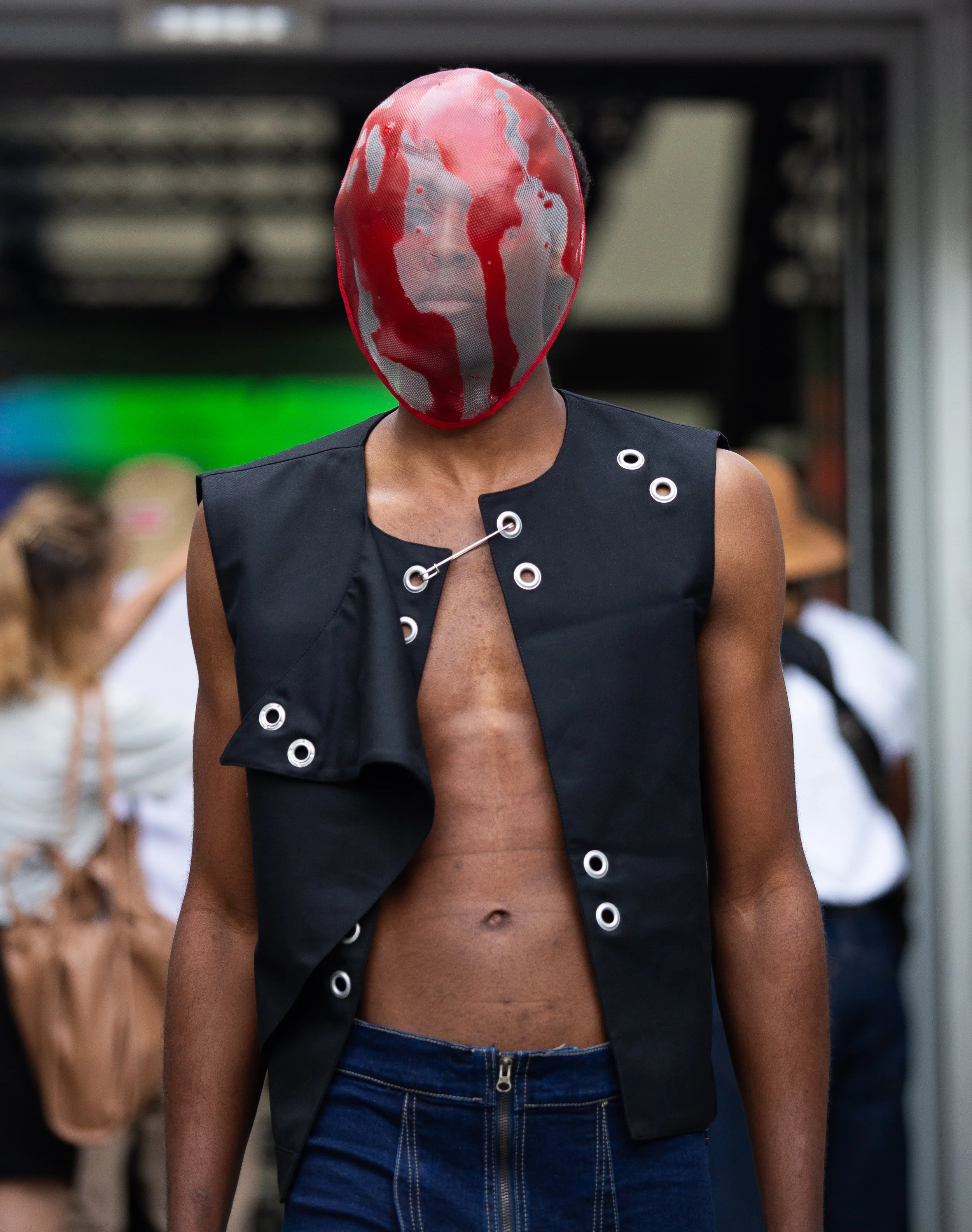
Photo by Sara Matov
Photos courtesy Genaro Rivas