Credits: Artwork: © Sebastião Salgado. Exhibition photograph: Isabela Espindola / Avesso Magazine.
There is something profoundly moving about standing before a photograph by Sebastião Salgado. His images possess a rare ability to transcend the boundaries of photography, transforming landscapes, human experiences and natural phenomena into powerful reflections on our relationship with the planet. In Aqua Mater, the celebrated Brazilian photographer's exploration of water becomes both a visual celebration of life and a compelling reminder of its fragility.
Opening in Madrid on 28 October 2026, the exhibition brings together, for the first time, selections from Salgado's Aqua Mater and Glaciares photographic series. Presented at Fundación Canal and organised in collaboration with La Fábrica, the exhibition features nearly 100 large-format black-and-white photographs, capturing more than two decades of journeys across some of Earth's most remote and extraordinary landscapes. Curated and designed by Lélia Wanick Salgado, the photographer's lifelong creative collaborator and wife, the exhibition carries particular emotional significance following his death in May 2025. It offers an opportunity to revisit the artistic and environmental legacy of one of Brazil's most influential photographers, whose work consistently challenged audiences to look beyond the image and consider the world it represents.
The Living Landscapes of a Changing Planet
Among the exhibition's most striking elements is its exploration of glaciers, immense formations of ice that Salgado photographed across Antarctica, Patagonia, Canada, the Himalayas and other remote regions. His photographs reveal landscapes of extraordinary scale, where towering mountains, frozen valleys and monumental glaciers appear almost untouched by human presence. The absence of colour intensifies their sculptural qualities, allowing contrasts between light, shadow, ice and rock to create compositions of remarkable depth.
Yet beneath their visual magnificence lies an increasingly urgent environmental narrative. Glaciers are among the most visible indicators of climate change. Rising global temperatures are accelerating ice loss across many regions, threatening freshwater reserves, transforming ecosystems and contributing to rising sea levels. Through Salgado's lens, these landscapes become more than geographical formations. They emerge as witnesses to a changing climate.
Credits: Artwork: © Sebastião Salgado. Exhibition photograph: Isabela Espindola / Avesso Magazine.
For the photographer, glaciers were never simply static masses of ice. Their movement, transformation and sounds suggested something almost organic, as though these frozen landscapes possessed a life of their own. This perspective introduces a particularly poignant dimension to the exhibition. What appears permanent in a photograph may already be undergoing profound transformation in reality.
Images of immense ice formations, dramatic coastlines and glaciers descending towards the ocean invite visitors to contemplate both the extraordinary forces that shape our planet and the consequences of disrupting its delicate environmental balance. The photographs are breathtaking, but their beauty is inseparable from a sense of vulnerability.
Water as the Essence of Life
Beyond the frozen landscapes, Aqua Mater expands its narrative to explore water as a fundamental element connecting people, biodiversity and the natural environment. Across continents, Salgado documented the many ways societies depend upon water. Rivers sustain agricultural production, coastal waters support fishing communities, and freshwater sources shape settlement patterns, cultural practices and livelihoods.
His photographs reveal this relationship through scenes of everyday life, capturing communities whose activities remain deeply connected to rivers, lakes and other aquatic environments. Some images highlight the consequences of water scarcity, particularly in vulnerable regions where limited access to safe water compromises hygiene, health and human dignity.
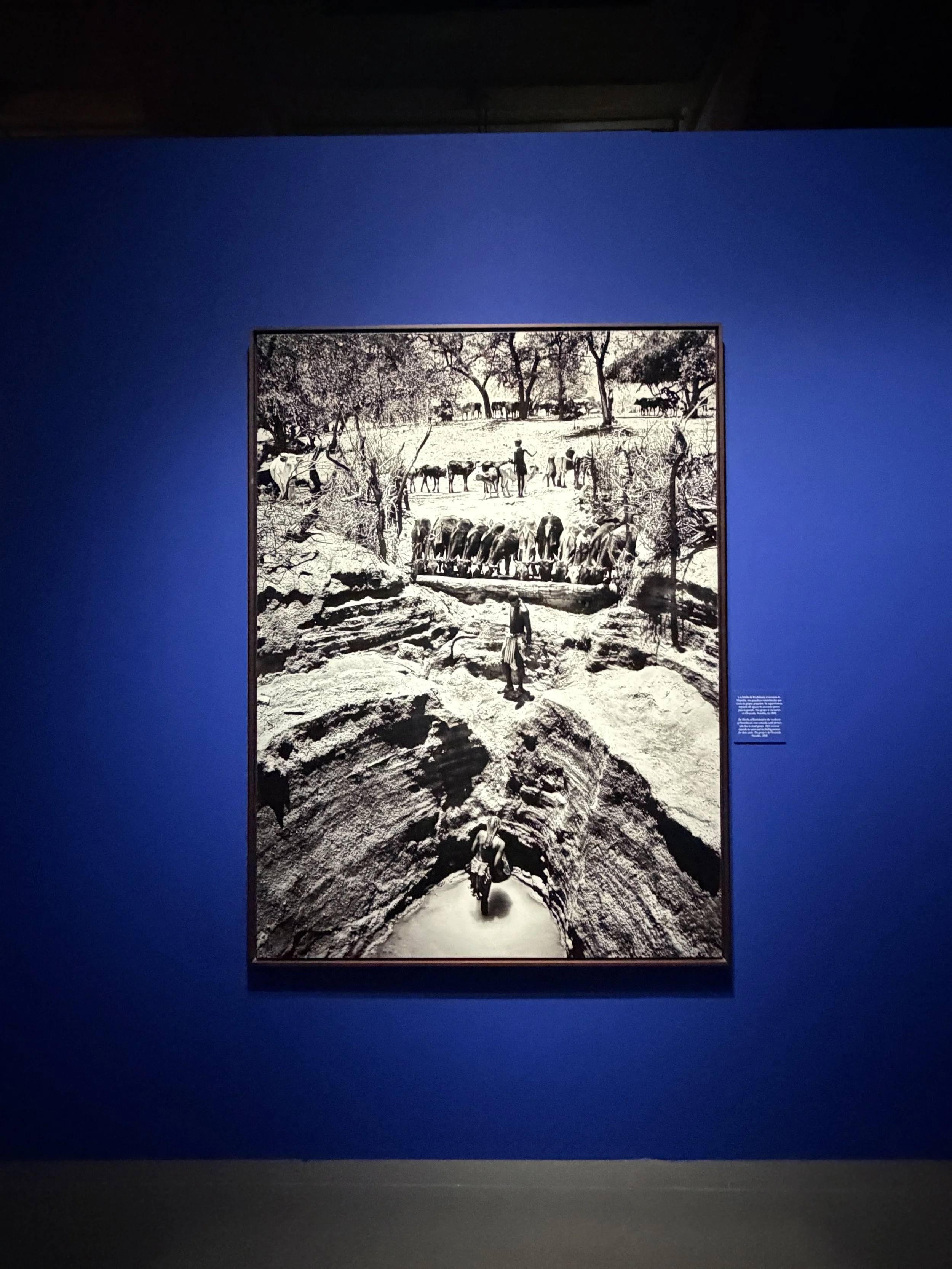
A photograph from Ethiopia in 1984, accompanied by an account of the work undertaken by Oxfam to establish wells in Bati, illustrates the challenges faced by communities where available water could barely meet essential drinking and cooking needs. Elsewhere, the exhibition turns towards Indigenous communities and traditional ways of life, including photographs from the Brazilian Amazon. These images reveal relationships with water that extend beyond its immediate practical uses, reflecting cultural identities, ecological knowledge and longstanding connections with the surrounding environment.
Credits: Artwork: © Sebastião Salgado. Exhibition photograph: Isabela Espindola / Avesso Magazine.
The contrast between abundance and scarcity is particularly powerful. Water appears throughout the exhibition as a source of beauty, sustenance, movement and survival. Its presence shapes landscapes and communities, while its absence exposes the vulnerabilities of both. Rather than presenting water solely as a natural resource, Salgado invites visitors to understand it as an essential element within a much larger network of ecological and human relationships.
From the Amazon to the Pantanal: Brazil's Ecological Richness
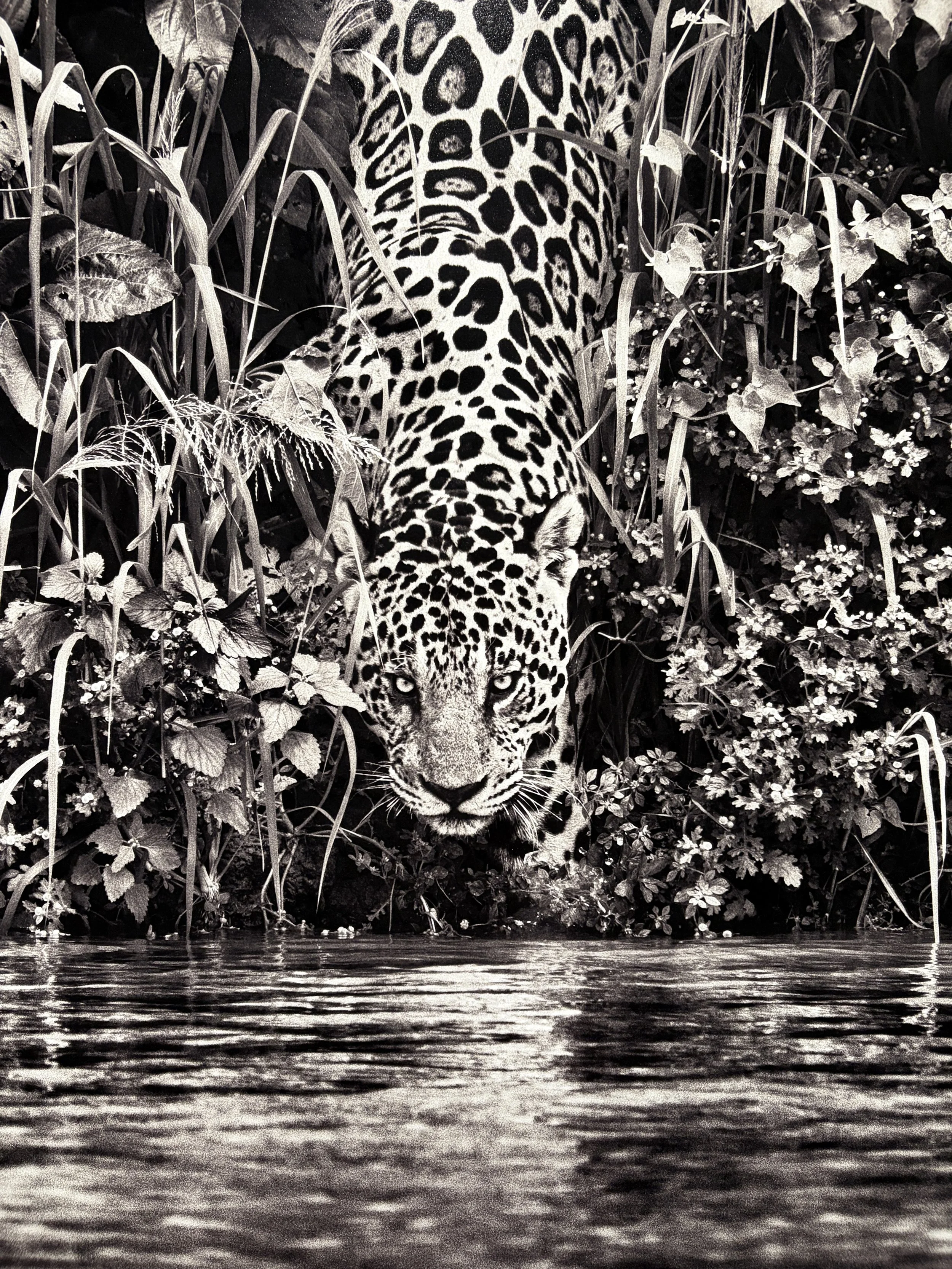
For Brazilian audiences, the exhibition offers an especially meaningful connection to the country's extraordinary biodiversity and natural heritage. Among its memorable images is a jaguar approaching the water's edge in the Pantanal, one of the world's largest tropical wetlands and a landscape renowned for its ecological richness.
The photograph captures a moment of extraordinary intimacy. The animal emerges from dense vegetation, its distinctive markings contrasting with the surrounding foliage, while the water in the foreground reflects the delicate relationship between wildlife and habitat. It is a powerful example of Salgado's ability to portray nature with both precision and sensitivity.
The Pantanal's seasonal flooding patterns sustain an intricate network of habitats, supporting remarkable concentrations of wildlife. Water is not merely part of the landscape; it is one of the principal forces determining the rhythms of life. In the Amazon, meanwhile, photographs of rivers, tropical storms and Indigenous communities reveal another dimension of Brazil's relationship with water. These environments also illustrate the interconnected nature of environmental challenges. Changes in rainfall patterns, deforestation, ecosystem degradation and climate change can have consequences extending far beyond individual landscapes. Through these images, Salgado's work reinforces the importance of recognising biodiversity conservation and water protection as inseparable priorities.
A Historic Water Reservoir Becomes Part of the Story
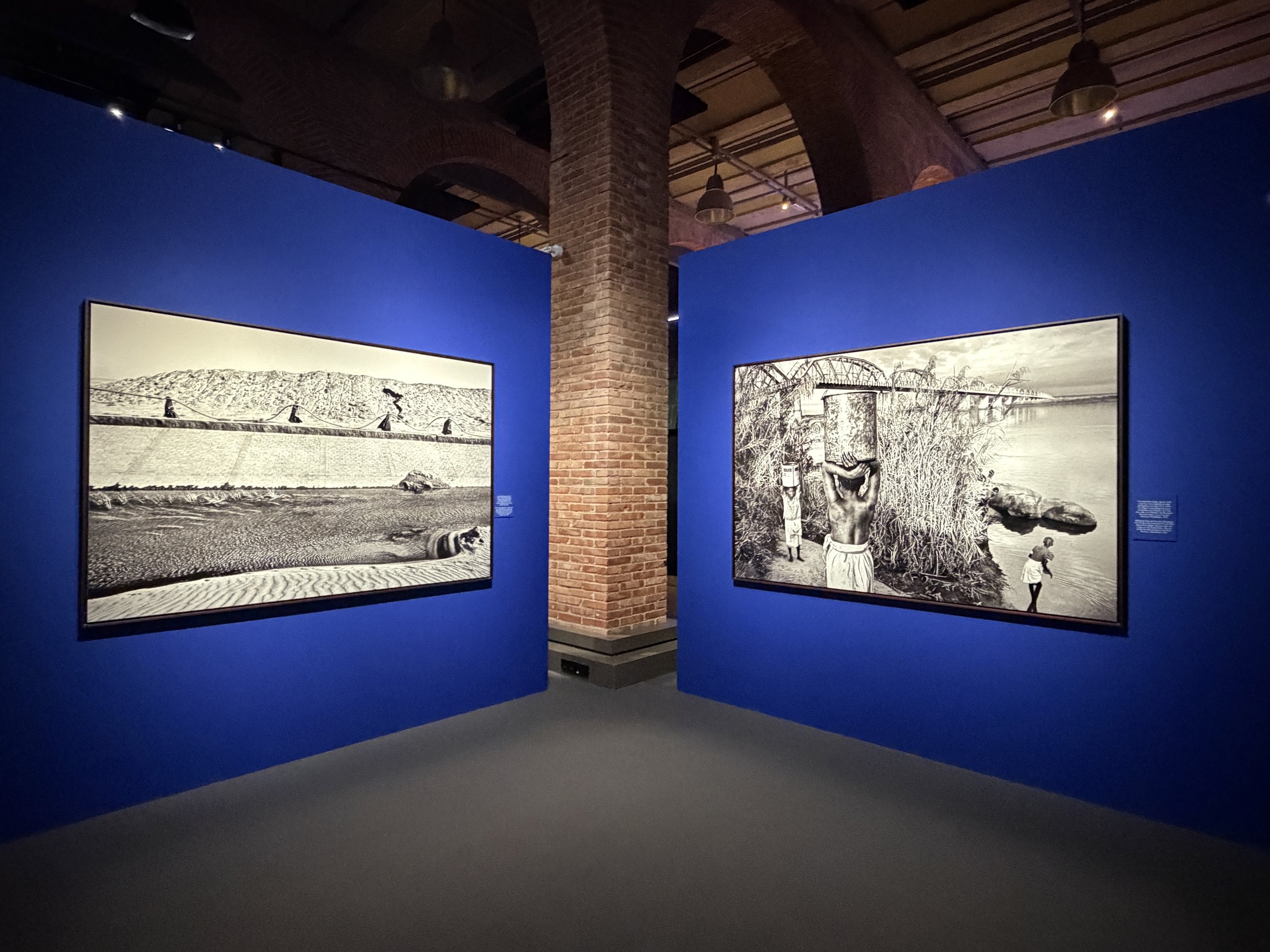
One of the most distinctive aspects of the Madrid exhibition is its setting. Aqua Mater is presented in Fundación Canal's Sala Castellana 214, a former water storage facility associated with Canal de Isabel II, Madrid's historic water utility. The underground reservoir began operating in the early 1940s to supply neighbourhoods that had developed during the city's expansion, including Cuatro Caminos and Salamanca. At its peak, the facility could hold approximately 180 million litres of water.
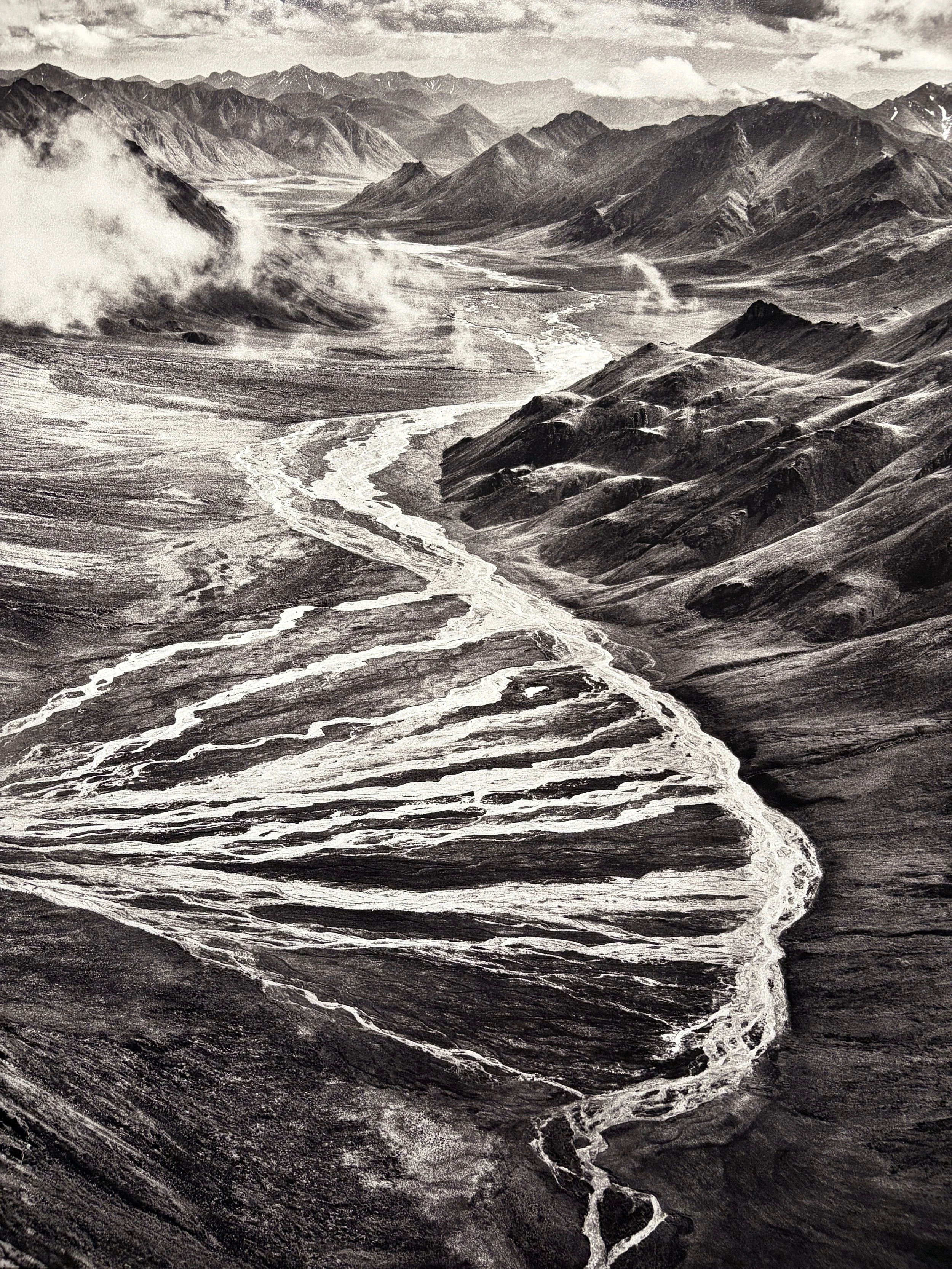
Credits: Artwork: © Sebastião Salgado. Exhibition photograph: Isabela Espindola / Avesso Magazine.
Today, the exhibition space retains its monumental architectural character, with imposing brick columns, expansive interiors and a distinctly industrial atmosphere. This architectural heritage introduces an additional layer of meaning to Salgado's photographs. Visitors are not simply observing images about water inside a conventional gallery. They are experiencing them within an infrastructure originally designed to store and support the distribution of that same essential resource.
The setting creates a compelling dialogue between artistic representation and the practical systems that sustain urban life. The exhibition also coincides with two institutional milestones: the 175th anniversary of Canal de Isabel II and the 25th anniversary of Fundación Canal. In this context, Aqua Mater becomes a celebration not only of water's natural beauty but also of its historical, cultural and societal importance.
A Legacy That Extends Beyond Photography
Throughout his career, Sebastião Salgado used photography to document some of the defining social and environmental issues of contemporary history. His commitment to conservation extended beyond the camera. Alongside Lélia Wanick Salgado, he established Instituto Terra in Brazil, an organisation dedicated to environmental restoration, reforestation and the recovery of degraded ecosystems in the Atlantic Forest.
This commitment provides an important context for understanding Aqua Mater. The exhibition is not simply a collection of extraordinary photographs of water. It reflects a broader philosophy in which environmental protection, human wellbeing and the preservation of biodiversity are fundamentally interconnected. In an era increasingly defined by climate uncertainty, freshwater pressures and ecological transformation, Salgado's photographs invite audiences to reconsider what is at stake.
The melting of glaciers, the degradation of wetlands and the difficulties faced by communities without reliable access to water are different expressions of a shared environmental challenge. Yet the exhibition does not rely exclusively on images of destruction or loss. Instead, it celebrates the remarkable beauty, resilience and complexity of the natural world, suggesting that appreciation and emotional connection can become powerful starting points for environmental awareness. Perhaps this is the enduring strength of Sebastião Salgado's photography: its ability to make distant landscapes feel intimate and global environmental concerns deeply personal.
In Madrid, Aqua Mater offers more than an encounter with the work of a remarkable photographer. It is an invitation to recognise water as the thread connecting ecosystems, societies and generations. And in a world where that connection is increasingly under pressure, Salgado's images remind us that protecting water ultimately means protecting life itself.
*Exhibition photography by Isabela Espindola for Avesso Magazine. Original photographic works by Sebastião Salgado. Exhibition curated by Lélia Wanick Salgado.