Solar Identity: Redefining Brazil-Core Under a Luxury Lens

Pelé in motion during the 1970 World Cup in Mexico. Reclaiming the warmth and texture of Brazil’s definitive era.
I must admit to holding a rather ambivalent relationship with major sporting tournaments. I am not the sort of person who thoroughly grasps the offside rule, nor do I spend my Sundays fervently tracking European league statistics. Yet, as the World Cup approaches, a curious shift occurs within my aesthetic perception. Suddenly, the world seems viewed through a lens where green, yellow, and blue cease to be merely the institutional colors of a national flag and instead become a promise of pure vibration. For me, sports serve as the perfect pretext for an analysis of behavior and style.
In recent seasons, the international market has attempted to label our visual identity under the somewhat reductionist moniker of “Brazil-Core.” We witnessed football jerseys paraded down the streets of Paris and New York, juxtaposed with sharp tailoring and stiletto heels—an urban appropriation that certainly possesses its own charm, but one that frequently merely scratches the surface of what Brazil truly represents in design. What is unfolding now, on the eve of yet another global tournament, is something infinitely more sophisticated: an elegant emancipation of our own aesthetic.
Dressing in tropical hues without collapsing into the cliché of a carnival costume or falling prey to naive jingoism is an art that demands absolute precision. The secret, as with almost everything in life that touches upon elegance, lies in the choice of raw materials and the deconstruction of forms. The green we yearn to wear now is not an industrial, flag-printed green, but the organic shade of banana leaves caught in the morning light, translated into pure, heavy-weight linens with an impeccable drape. The yellow is not the jarring neon found in stadium stands, but a warm, solar ochre—almost golden—that evokes the crisp modernism of Brasília and sun-drenched afternoons in the northeastern coastal resorts.
Domestic high-end brands and designers with a cosmopolitan gaze have come to understand that true Brazilian luxury is solar, fluid, essentially tactile—and, above all, profoundly democratic. The genuine sophistication of this new wave lies in crafting garments that embrace every type of body, celebrating the beautiful diversity of our silhouettes with identical reverence and flawless fit. It is about capturing that elusive bossa—our unique innate ability to look entirely sophisticated without looking as though we tried at all—and applying it to shapes that transition seamlessly from a beachside lunch in Trancoso, to the vibrant, laid-back energy of a traditional neighborhood boteco on a Sunday afternoon, to a high-stakes business meeting in London. Consider an impeccably cut suit made of raw silk in a deep Bahia-blue, or sweeping dresses adorned with intricate crochet by local artisans that seem to sculpt the plurality of each form with the sheer weightlessness of a sea breeze. This is no longer mere team fandom, it is a style manifesto.
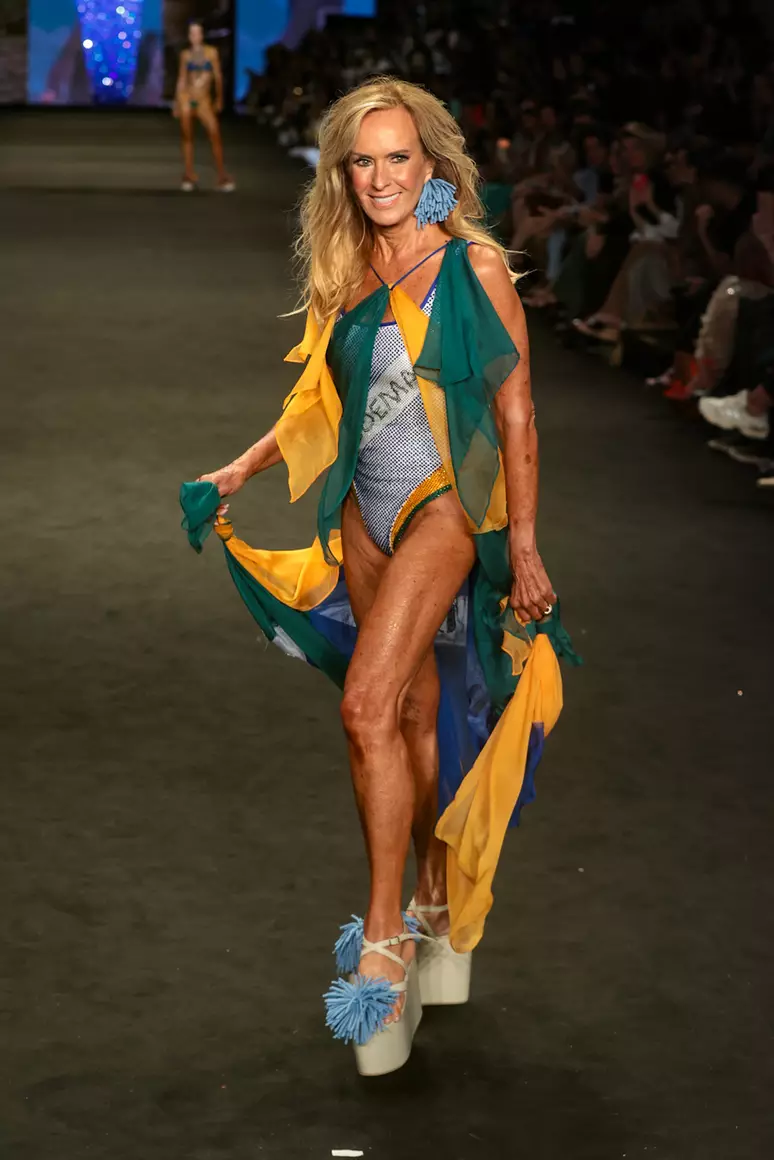
The eternal muse Helô Pinheiro on the Blue Man runway: a living testament to Brazil's enduring solar identity, effortless bossa, and a beautiful celebration of body democracy across generations.
There is a fascinating psychological dimension to this movement. For years, wearing national colors outside the strict confines of a stadium carried socio-political tensions that extended far beyond fashion. Watching haute couture and luxury prêt-à-porter reclaim these tones acts as a form of cultural curation. We are reclaiming the right to celebrate our own palette. And we do so not through loud noise, but through design excellence. When Brazilian fashion elevates these symbols, it exports not a cheap, exotic fantasy, but our architecture, our unparalleled light, and our indomitable sophistication.
The upcoming World Cup will undoubtedly provide a spectacle of athletic prowess on the pitch. But off the field, on cosmopolitan sidewalks and inside elegant salons, the verdict has already been rendered: our solar identity is the most charming trend of the season. True elegance, after all, consists of belonging to a place, carrying its specific light upon one’s skin and clothing, and yet remaining perfectly understood anywhere in the world. And if there is one thing Brazil knows how to do when it chooses to dress for the world, it is to enchant from the inside out.