Cecilia Vicuña: Living Threads and the Art of Human Rebellion
Credits: Installation view, ‘Cecilia Vicuña: Living Threads’, Whitechapel Gallery, London, 07 October 2026 - 14 February 2027. Photo © Rob Harris.
I first encountered Cecilia Vicuña’s work a couple of years ago, when one of her installations was presented at Tate Modern in London. It was, for me, love at first sight. There was something immediately compelling about the way she transformed seemingly fragile materials into something capable of carrying immense emotional and political weight. Her work did not ask me to separate aesthetics from history, or beauty from the uncomfortable realities that shape our world. Instead, it brought them together.
Returning to her practice at Whitechapel Gallery, where Cecilia Vicuña: Living Threads presents the first major UK exhibition dedicated to the Chilean artist and poet, feels like an opportunity to understand more deeply what had drawn me to her work in the first place. Spanning six decades, the exhibition follows an artistic practice that refuses to remain within the boundaries of a single discipline, moving between painting, textiles, photography, installation, film, poetry, performance and activism.
Vicuña’s work is rooted in a distinctly Latin American perspective, one in which art cannot be detached from the political conditions in which it is made. Her practice is shaped by histories of colonialism, displacement and resistance, as well as by a profound engagement with Indigenous knowledge and ecological fragility. These are not separate subjects in her work. They are interwoven, much like the threads that recur throughout her installations.
Vicuña has described art as a form of deep human rebellion. Seen through this lens, her work becomes more than an exploration of materials or an experiment in form. It is a refusal to accept the erasure of cultures, languages, memories and ways of understanding the world that have been marginalised by dominant political and cultural systems.
An artist shaped by exile
Born in Santiago, Chile, in 1948, Vicuña came to London in the early 1970s to study at the Slade School of Art. Her time in the city coincided with one of the most consequential ruptures in modern Chilean history: the military coup against President Salvador Allende in 1973. In its aftermath, she remained in exile, and her experience of displacement, loss and political violence became increasingly central to her artistic practice.
London was therefore not simply a place of artistic development. It became part of the historical and personal landscape through which she understood the relationship between art and political responsibility. The exhibition gives particular attention to this period through a dedicated presentation of Artists for Democracy, the organisation Vicuña co-founded in London in 1974 with David Medalla, John Dugger and Guy Brett. Established in solidarity with Chile and other liberation struggles around the world, the organisation positioned artistic practice within a wider movement for political change.
Credits: Installation view, ‘Cecilia Vicuña: Living Threads’, Whitechapel Gallery, London, 07 October 2026 - 14 February 2027. Photo © Rob Harris.
Bringing together documents, photographs and printed materials, including previously unseen archival material, this section makes visible a dimension of Vicuña’s practice that can be overlooked when her work is encountered primarily through its visual or poetic qualities. Her art did not become political only through symbolism. It was also connected to collective action, solidarity and the question of what artists might do in response to violence and injustice. This is one of the exhibition’s most important propositions: that art can create spaces in which histories are remembered, resistance is sustained, and alternative ways of imagining society become possible.
The language of threads
The threads that run through Vicuña’s work are both material and conceptual. They connect past and present, individual and collective memory, human beings and the ecosystems on which they depend. They also offer a way of thinking about knowledge beyond the written word.
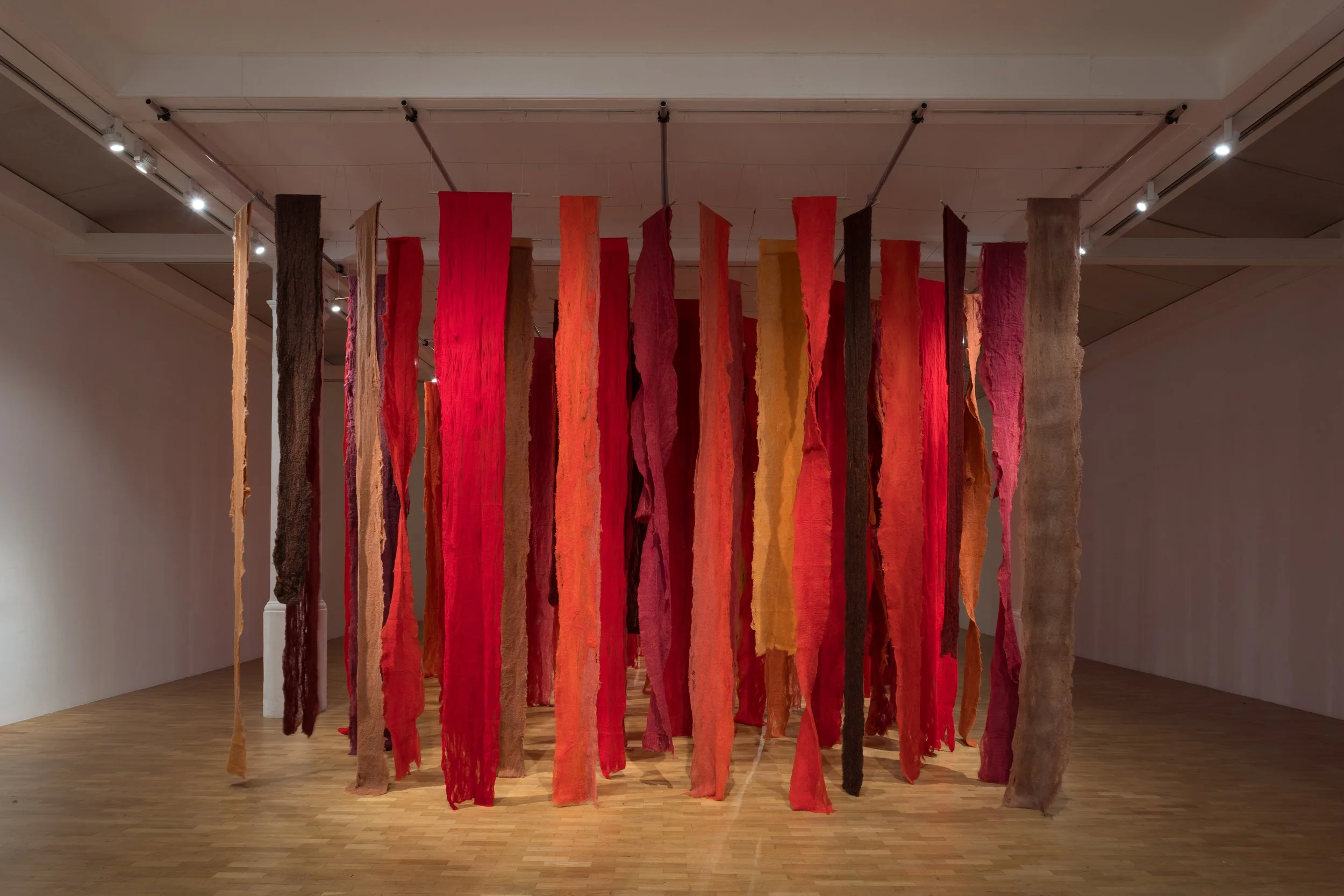
One of the exhibition’s central works is Quipu Menstrual (2006–2024), a large-scale sculptural installation composed of unspun wool in vivid shades of red and brown, suspended from the ceiling. Its presence is striking, yet its significance extends beyond its physical scale. The work belongs to Vicuña’s long engagement with the quipu, an ancestral Andean system of communication based on knots and cords.
For more than five decades, she has returned to this form, treating it as a living point of connection with Indigenous systems of knowledge. The quipu challenges the assumption that communication must depend on alphabetic writing, inviting us to consider how memory, information and relationships might be held in other forms.
Credits: Installation view, ‘Cecilia Vicuña: Living Threads’, Whitechapel Gallery, London, 07 October 2026 - 14 February 2027. Photo © Rob Harris.
The threads do not simply represent something else. They become a way of thinking: a means of connecting knowledge, bodies, histories and environments.
In Quipu Menstrual, the rich red and brown tones introduce further associations with the body, life and cycles of existence. The work asks to be experienced as a physical presence, but it also opens onto questions about the ways in which knowledge has been preserved, suppressed or dismissed.
There is a particular force in encountering such a work within a major London institution. The quipu brings an Indigenous Andean tradition into a contemporary gallery, not as a relic of the past but as a form of knowledge that remains relevant to how we understand the present.
The beauty of the precarious
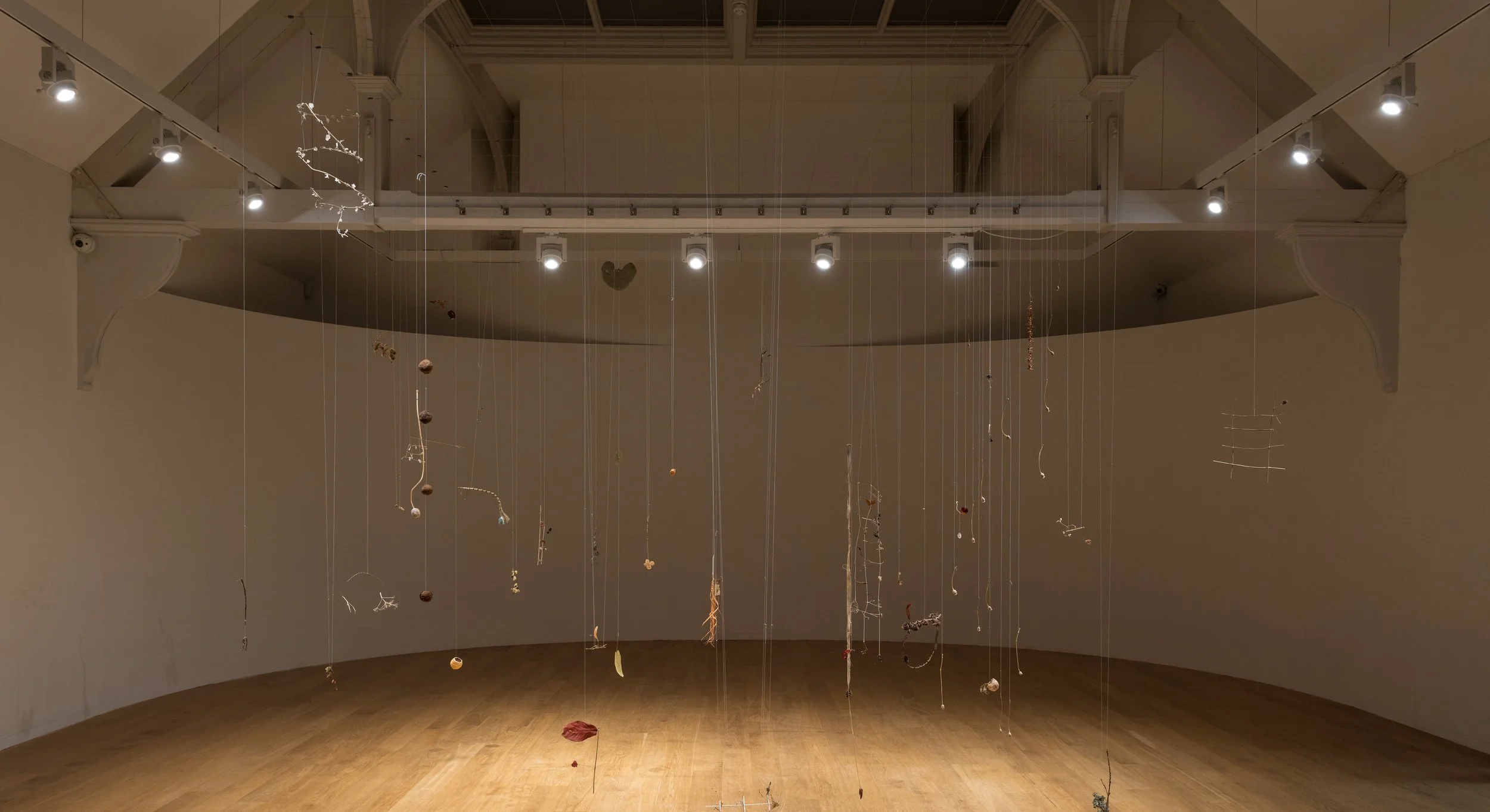
Another defining element of Vicuña’s practice is her interest in fragility and impermanence. Beginning in the mid-1960s, she developed a series of small sculptures known as precarios, made from found and discarded materials including paper, printed matter, fabric and feathers.
These works challenge conventional ideas about sculpture as something permanent, self-contained and designed to endure. Their materials are often humble, their structures delicate and their existence temporary. They resist the monumental certainty traditionally associated with art objects.
The exhibition includes the only surviving work from the precarios series that Vicuña made during her time in London, alongside documentation of approximately 400 works from the same collection that have been lost.
Credits: Installation view, ‘Cecilia Vicuña: Living Threads’, Whitechapel Gallery, London, 07 October 2026 - 14 February 2027. Photo © Rob Harris.
The absence is significant. Rather than treating disappearance simply as a problem to be resolved, Vicuña’s practice allows impermanence to become part of the work’s meaning. Materials change, objects disappear, and memories become vulnerable. What remains is not always the physical object, but the traces it leaves behind and the relationships it once made possible.
There is something quietly radical in this approach. In a culture that often measures value through permanence, accumulation and ownership, the precarios propose another understanding of artistic significance. A work does not necessarily need to last forever to matter. Its fragility may be precisely what makes us pay attention.
Poetry as resistance
Vicuña’s interdisciplinary approach also comes into focus through her paintings from the 1970s, created during her time in London, and her Palabrarmas series, which she began during this period.
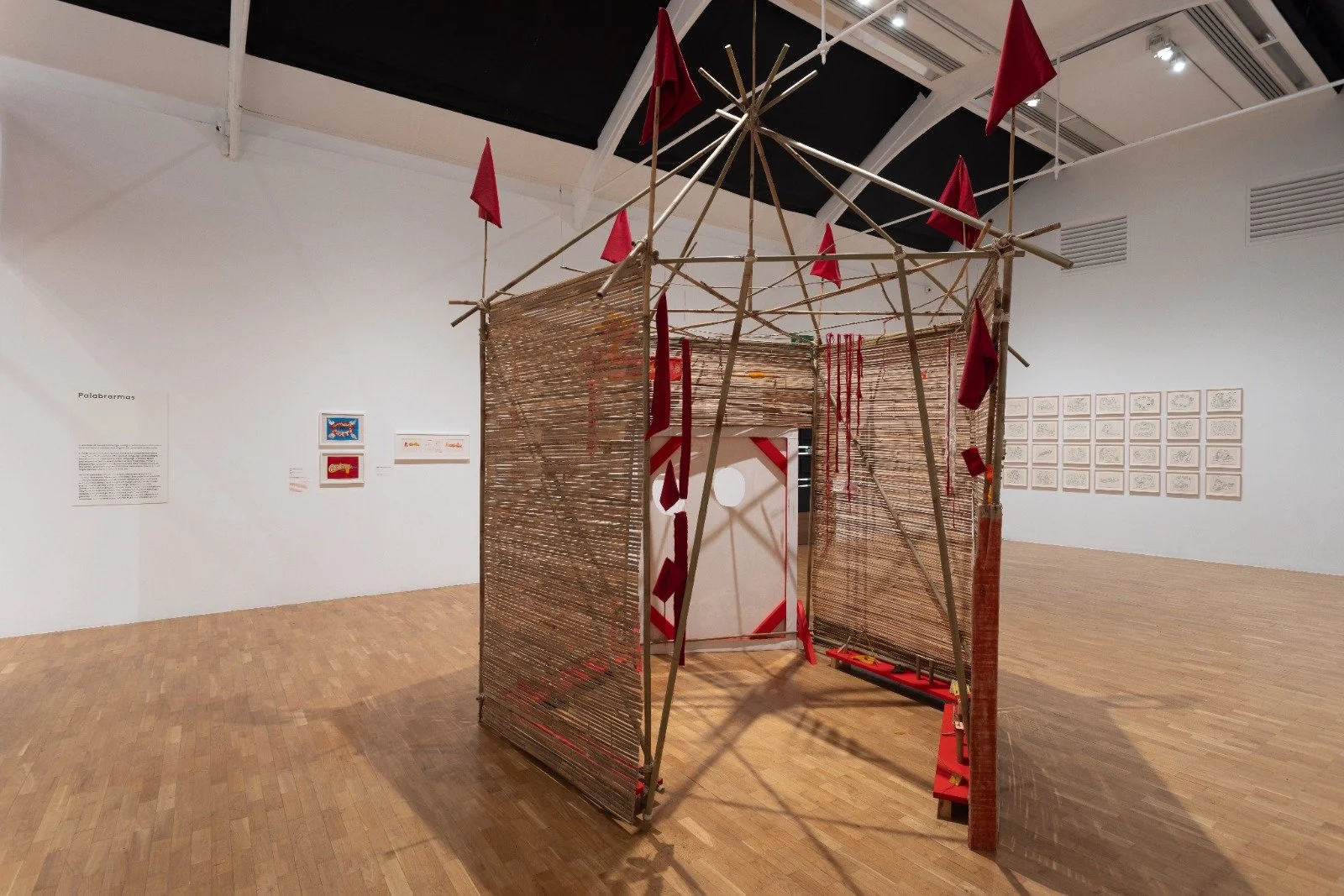
The series brings language into the visual field, exploring the material and political possibilities of words. For Vicuña, poetry is not confined to the page, just as art is not confined to the gallery. Language can be broken apart, rearranged and transformed, revealing meanings that conventional structures might obscure.
Her work moves between image and word, object and gesture, individual expression and collective history. It is a practice that encourages us to question the divisions through which culture is often organised: art on one side, politics on another; poetry separate from activism; nature treated as a backdrop to human life.
Vicuña brings these elements into conversation because, in her understanding of the world, they have never truly been separate.
Her commitment to Indigenous knowledge and ecological preservation further expands this vision. Many of her installations act as forms of remembrance for cultures, languages and ways of living threatened by colonial systems and dominant Western models. Their political significance is inseparable from their environmental dimension. To protect a language, a tradition or a relationship with the land is also to defend the possibility of a different future.
Beyond the gallery
What stayed with me when I first encountered Vicuña’s work at Tate Modern was its ability to make fragility feel powerful. Returning to it at Whitechapel Gallery, I am struck by how that quality connects the different strands of her practice, from the delicate precarios to the expansive forms of her quipus and the political urgency of her work in London during the 1970s.
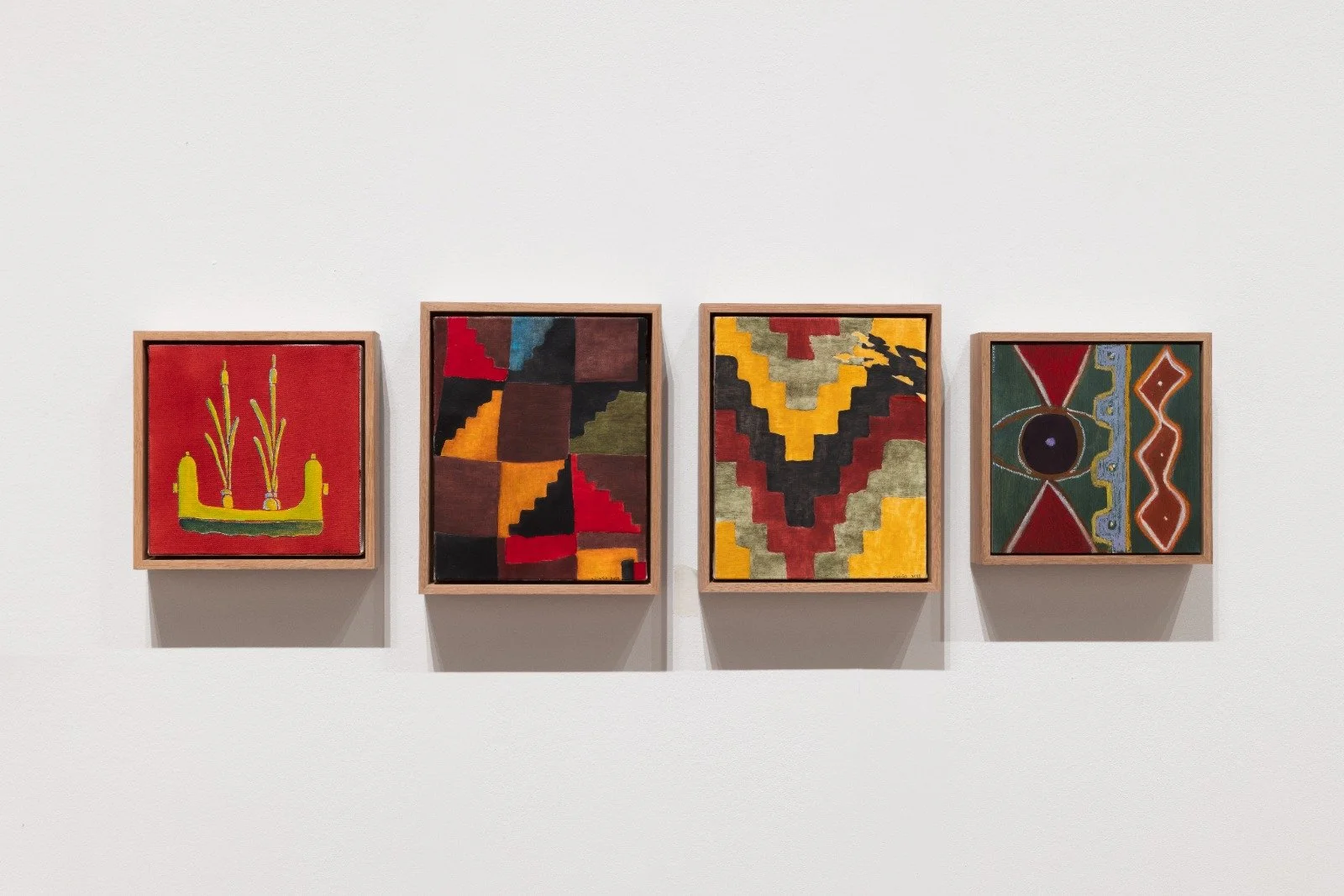
Credits: Installation view, ‘Cecilia Vicuña: Living Threads’, Whitechapel Gallery, London, 07 October 2026 - 14 February 2027. Photo © Rob Harris.
Her art does not offer the comfort of treating political engagement as an external subject that can be contemplated from a safe distance. Instead, it asks us to recognise how power shapes the things we preserve, the histories we remember and the knowledge we choose to value.
This is where Vicuña’s Latin American perspective feels particularly important. Her work emerges from a history in which colonialism, political intervention and cultural resistance are inseparable from questions of identity and belonging. Yet it does not remain confined to a national or regional narrative. By connecting those histories to ecological destruction, collective memory and the fragility of human relationships, she makes them resonate far beyond Chile.
There is also a challenge here to the way contemporary culture understands rebellion. Resistance does not always arrive through monumental gestures or direct confrontation. It can take the form of a thread, a knot, a word or an object assembled from what others have discarded. It can lie in the decision to preserve a memory, to recognise a form of knowledge that dominant systems have ignored, or to imagine a relationship with the natural world that is not based on control and extraction.
At Whitechapel Gallery, Living Threads brings these ideas together without reducing Vicuña’s work to a single message. Its power lies in the connections it makes possible, between art and activism, the intimate and the collective, the fragile and the enduring.
Perhaps this is what makes her work feel so immediate. It reminds us that art need not stand apart from the world to offer a way of seeing it differently. Sometimes, its deepest act of rebellion is simply to reconnect what has been separated, and to insist that even the most fragile thread can hold a history, a community or a possibility for change.