Renoir and Love: Why We Need to Look at Love More Closely
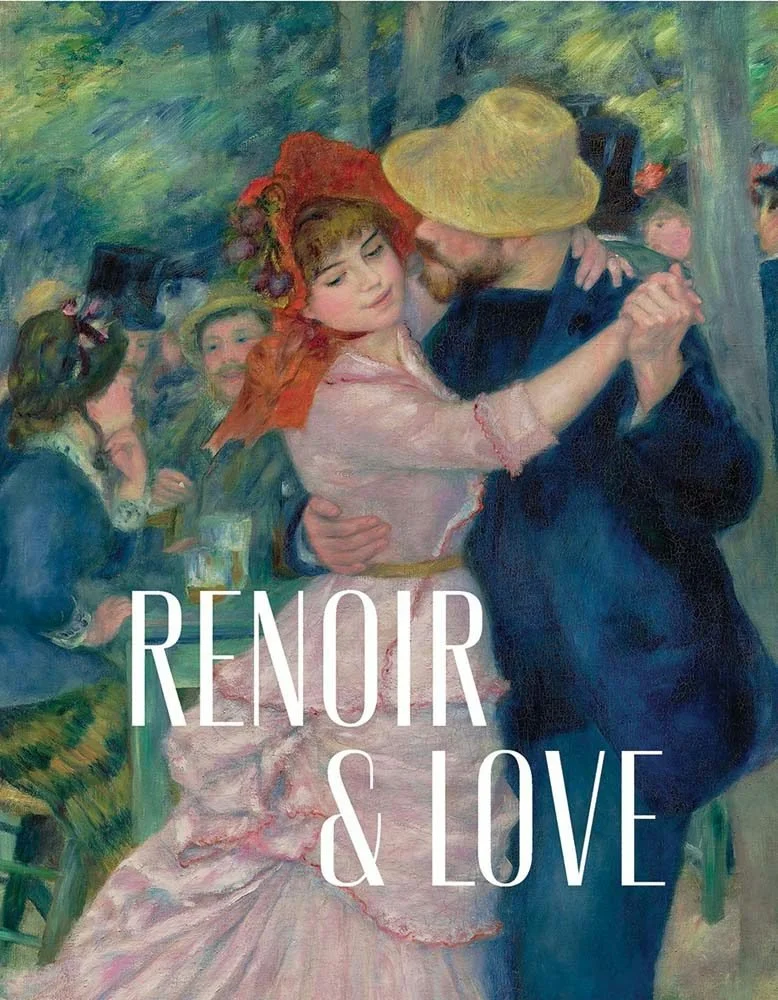
Credits: own archive
There are exhibitions you admire, exhibitions that teach you something new, and exhibitions that leave you wanting to take a piece of them home. When I visited Renoir and Love at the National Gallery on behalf of Avesso Magazine, I found myself experiencing all three.
Pierre-Auguste Renoir has long been one of my favourite artists of the Impressionist period. There is something about the way he paints people that has always drawn me in: the warmth of his colours, the movement of a scene, the softness of a glance and the feeling that, for a brief moment, we have been allowed into somebody else’s life. His paintings seem to hold on to the fleeting pleasures of being human. They invite us to look beyond what is happening in a scene and consider what might be passing between the people within it.
At the National Gallery, that quality becomes the organising principle of an exhibition that is as thoughtful in its presentation as it is beautiful in its individual works. Moving through the rooms, I was struck by how carefully the paintings, photographs, frames and supporting material had been brought together. Rather than simply assembling celebrated works by a celebrated artist, the exhibition builds a narrative. It allows us to follow Renoir’s changing artistic interests while tracing the many forms love can take, from flirtation and friendship to family life and the quieter intimacies of everyday existence.
I spent time in every room, returning to details and allowing the paintings to speak to one another. By the time I reached the exhibition book, I knew I wanted to buy it. That is an unusual response for me. I look at exhibition catalogues regularly, but only occasionally does one feel so closely connected to the experience I have just had. This was one of those rare occasions when I wanted to take the exhibition home, to revisit its images and continue thinking about the story it had told.
What stayed with me most, however, was the feeling that Renoir was asking us to pay attention. Not simply to beauty, but to the ways we look at one another, the affection that shapes our lives and the ordinary moments through which relationships become meaningful.
A painter of people, not just light
Renoir is often associated with the shimmering surfaces and luminous colours of Impressionism. His paintings capture sunlight filtering through trees, the movement of dancers, the lively atmosphere of outdoor cafés and the changing rhythms of modern Parisian life. Yet to approach his work only through its beauty is to miss something fundamental.
In the period explored by Renoir and Love, from the mid-1860s to the mid-1880s, the artist was developing a remarkably sustained interest in human connection. The exhibition brings together approximately 40 paintings, including loans from major international collections, to explore affection, seduction, friendship, sociability and parenthood. It is the most significant UK exhibition devoted to Renoir in two decades, and it offers an opportunity to reconsider an artist whose popularity has sometimes obscured the complexity of his work.
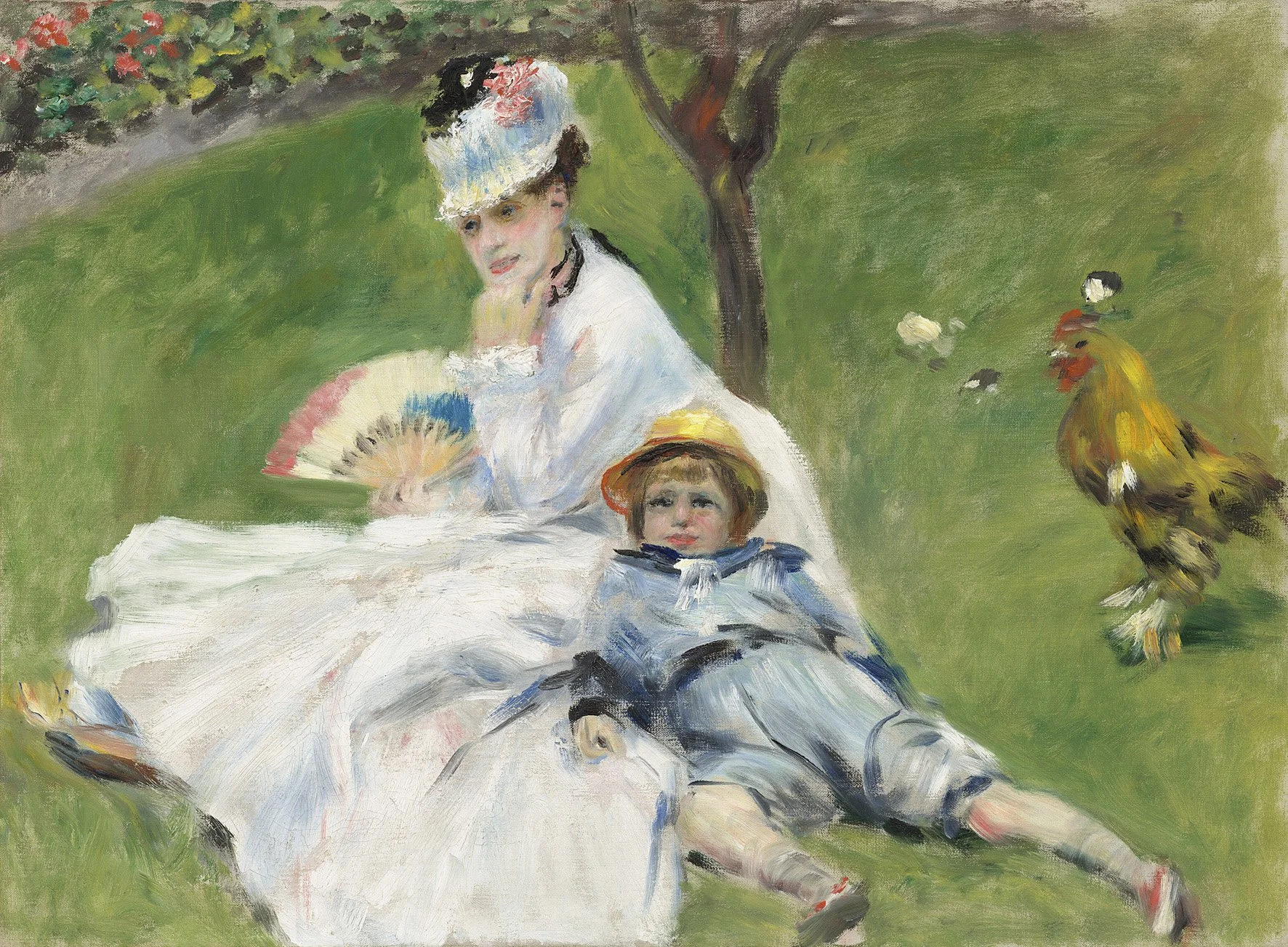
Credits: Pierre-Auguste Renoir, ‘Madame Monet and Her Son’, 1874. © National Gallery of Art, Washington, Ailsa Mellon Bruce Collection.
The exhibition’s central idea is that love is not confined to romantic declarations or exceptional moments. It can be found in the intimacy of conversation, the familiarity of a shared meal, the anticipation of a dance or the simple pleasure of being among friends. Renoir’s subjects inhabit a world in which social life itself becomes worthy of artistic attention.
This was a significant choice. In the nineteenth century, painting on a grand scale had traditionally been associated with religious, historical and mythological subjects. Renoir brought the experiences of contemporary life into that visual territory, treating ordinary people and their relationships as subjects deserving of serious artistic consideration. His work is therefore about more than capturing a beautiful moment. It is about recognising the importance of moments that might otherwise appear unremarkable.
That perspective feels especially relevant today. We live surrounded by images, many designed to capture attention for a few seconds before being replaced by the next. Renoir asks for a different kind of looking. His paintings reward patience. The longer we stay with them, the more we notice: a hand resting on a shoulder, a face turned towards another, a body leaning into the rhythm of music, the subtle distance between two people who may or may not be in love. The paintings are full of life, but they are not merely illustrations of happiness. They are observations of people negotiating the pleasures, uncertainties and possibilities of being together.
The beauty of a shared moment
One of the exhibition’s great strengths is the way it moves between private intimacy and collective life. Renoir’s world includes couples, families, friends, café-goers, dancers and people gathering for meals. Love is presented not as a single experience, but as something that takes shape differently depending on the people, the setting and the moment.
Among the exhibition’s most celebrated works is Dance at the Moulin de la Galette (1876), on loan from the Musée d’Orsay in Paris and displayed in the UK for the first time. The painting draws us into a lively gathering in Montmartre, where people dance, talk and enjoy the afternoon beneath the trees. Light filters through the scene, breaking across faces, clothes and the crowded ground. The composition feels alive with movement, yet the painting is not simply a record of a public dance.
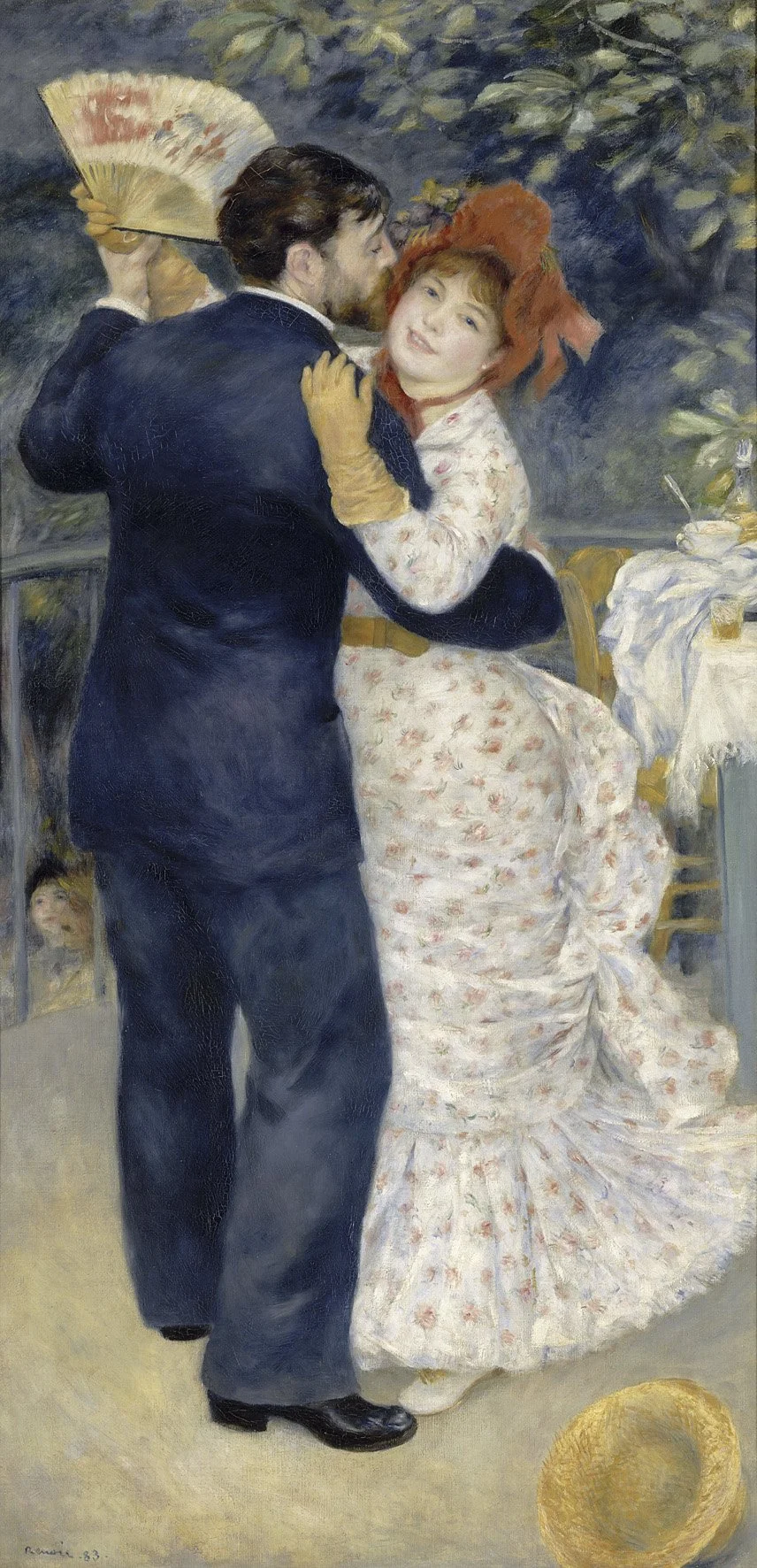
Credits: Pierre-Auguste Renoir, 'Dance in the Country', 1883, Musée d'Orsay, Paris (RF 1979 64) © photo Musée d’Orsay, Dist. RMN-Grand Palais / Patrice Schmidt
It is a portrait of sociability. We become aware of the many small interactions taking place simultaneously: couples moving together, friends talking, people observing one another and strangers sharing the same space. The painting offers the pleasure of looking at a crowd while allowing us to feel that each person is participating in a distinct human experience.
This is one of Renoir’s great gifts. He can make a large gathering feel intimate without reducing its complexity. The energy of the group and the individuality of its members coexist. Everyone belongs to the same scene, but no two encounters are quite alike.
In Dance at Bougival (1883), the focus narrows. Two figures turn towards one another, their bodies caught in the rhythm of the dance. The background seems to move around them, while the couple occupies a more concentrated emotional space. The painting captures the physical closeness of dancing, but also the possibility of a connection unfolding in real time.
Elsewhere, meals and conversations become occasions for the same kind of observation. In Lunch at the Restaurant Fournaise, also known as The Rowers’ Lunch (1875), Renoir depicts a gathering in which food, drink, conversation and companionship form a lively social world. The painting is generous in its attention to the pleasure of being together. It understands that a meal is rarely only about what is on the table. It is also about who is there, what is being said and the atmosphere that develops around shared food.
These scenes are deeply familiar, even across the distance of a century and a half. We still meet in restaurants, gather with friends, fall in love, enjoy the company of strangers and find ourselves changed by conversations we had not planned to have. Renoir’s world may belong to a particular moment in French history, but the emotions that animate it remain recognisable.
Aline Charigot and the intimacy of family
Of all the relationships explored in the exhibition, the one that resonated most personally with me was Renoir’s relationship with his wife, Aline Charigot. I was particularly moved by the way he painted her. There is a tenderness in these images that feels different from the more public pleasures of the dance halls and cafés. His paintings of family life invite us into a quieter world, where affection is expressed through familiarity, care and the repeated gestures of everyday existence.
Aline, who had been one of Renoir’s models, became his wife in 1890. Their family life became an important part of his world, and his paintings of motherhood and children offer some of the exhibition’s most intimate moments. In Motherhood (1885), Renoir depicts Aline nursing their first son, Pierre. The scene is direct and unassuming, yet its emotional force lies in precisely that simplicity. The relationship between mother and child is not presented as a distant ideal. It is a physical, lived experience, conveyed through closeness and the ordinary act of care.
Looking at these paintings, I found myself thinking about devotion. We cannot know everything about the private reality of an artist’s marriage from the images he leaves behind, but Renoir’s repeated attention to Aline and their family suggests that these relationships held a central place in his imagination. He returned to the people closest to him not merely as subjects, but as part of the world he wanted to paint.
There is something moving about seeing an artist known for his luminous depictions of public pleasure turn towards the intimacy of home. The same sensitivity that captures a crowded dance floor can also illuminate the quietness of a mother holding her child. Both scenes are about connection. Both depend on the ability to recognise emotion in gesture, posture and proximity.
For me, this was where the exhibition became particularly personal. The paintings did not ask me to admire an idealised version of love. They encouraged me to consider the different ways it becomes visible, and how often its most meaningful expressions are also its most ordinary.
An exhibition that tells a story
The curatorial structure is central to the experience. Each room builds on the previous one, creating a sense of movement through Renoir’s artistic development and his evolving understanding of modern life. The early works introduce his interest in everyday subjects and the social environments around him. The paintings of courtship and gallant encounters reveal his engagement with earlier French artistic traditions, while the café, street and dance scenes capture the energy of contemporary Paris. Later rooms turn towards the outskirts of the city, outdoor leisure, family life and more intimate forms of human interaction.
The sequence also reveals changes in Renoir’s style. In the early 1880s, he began moving away from the Impressionist emphasis on the fleeting effects of light towards more solid, sculptural forms. The exhibition allows us to see this shift without losing sight of the continuity in his subject matter. Even as his approach to painting changed, his fascination with people, affection and the pleasures of life remained.
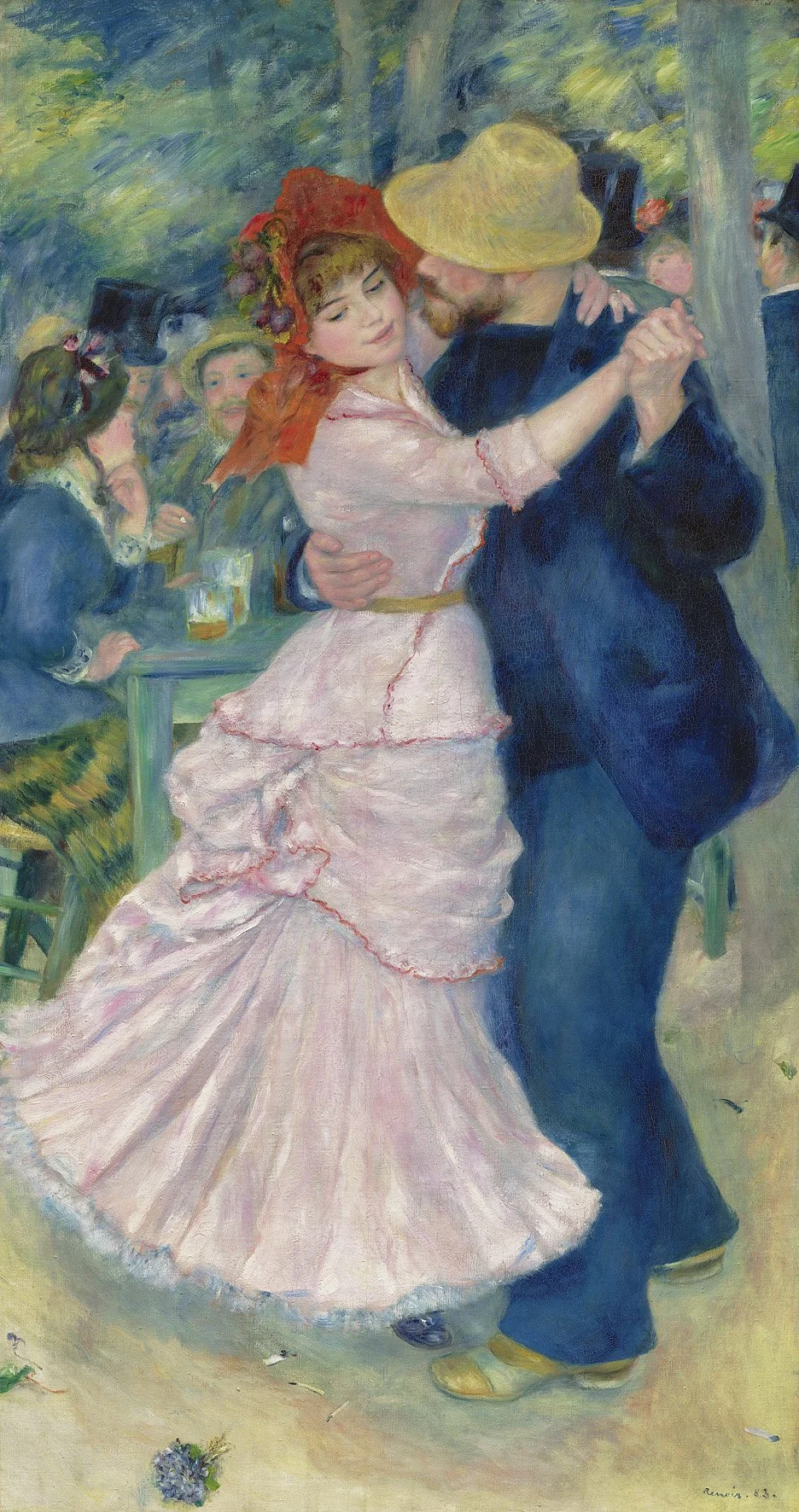
Credits: Pierre-Auguste Renoir, 'Dance at Bougival', 1883. Museum of Fine Arts, Boston. Picture Fund 37.375 Photograph: © 2026 Museum of Fine Arts, Boston
I particularly appreciated the way the exhibition’s visual presentation supported this journey. The framing, photographs, explanatory material and arrangement of the paintings felt carefully considered, creating an environment in which the works could be understood both individually and as part of a larger conversation. Nothing felt incidental to the experience. The presentation encouraged me to slow down, make connections and notice how the paintings responded to one another across the rooms.
That sense of coherence is not always easy to achieve in a major exhibition, particularly one bringing together works from museums and private collections around the world. Here, the loans serve a clear purpose. They help build a more complete picture of Renoir’s development during a crucial period of his career, rather than simply offering a succession of famous images.
The exhibition was initiated by the Musée d’Orsay and organised in partnership with the National Gallery and the Museum of Fine Arts, Boston. Having first been presented in Paris, it has now arrived in London before continuing to Boston in 2027. Its international journey reinforces the scale of the undertaking, but the experience in the gallery remains intimate. For all the scholarship and organisation behind it, the encounter ultimately comes down to standing in front of a painting and allowing it to affect you.
Why Renoir matters now
It would be easy to dismiss Renoir’s work as an uncomplicated celebration of happiness. His colours are warm, his subjects often appear at ease, and his paintings are filled with the pleasures of social life. But the exhibition encourages us to look more carefully at what that apparent lightness contains.
To celebrate joy is not necessarily to deny complexity. It can be a way of recognising what makes life worth living, particularly when the world feels uncertain or when our attention is pulled in too many directions. Renoir’s paintings return us to experiences that are fundamental to human life: affection, companionship, attraction, family, friendship and the simple pleasure of sharing time.
In a culture increasingly shaped by digital communication, curated identities and the pressure to document our experiences, there is something refreshing about art that asks us to inhabit a moment rather than capture it. Renoir’s figures are not presenting their lives to an audience beyond the painting. They are occupied with one another. They dance, talk, eat, flirt, care for their children and enjoy the company of friends.
Their world reminds us that connection is not always a grand event. It often emerges through attention: noticing another person, listening to what they say, recognising their presence and allowing a shared moment to become meaningful. This is also why the exhibition’s emphasis on love feels so important. Love here is not limited to romantic partnership. It includes the relationships that make up the fabric of a life, from friendships and family bonds to the temporary companionship of people gathered in a public place. Renoir understood that human connection is made up of countless gestures, some deliberate and others almost imperceptible.
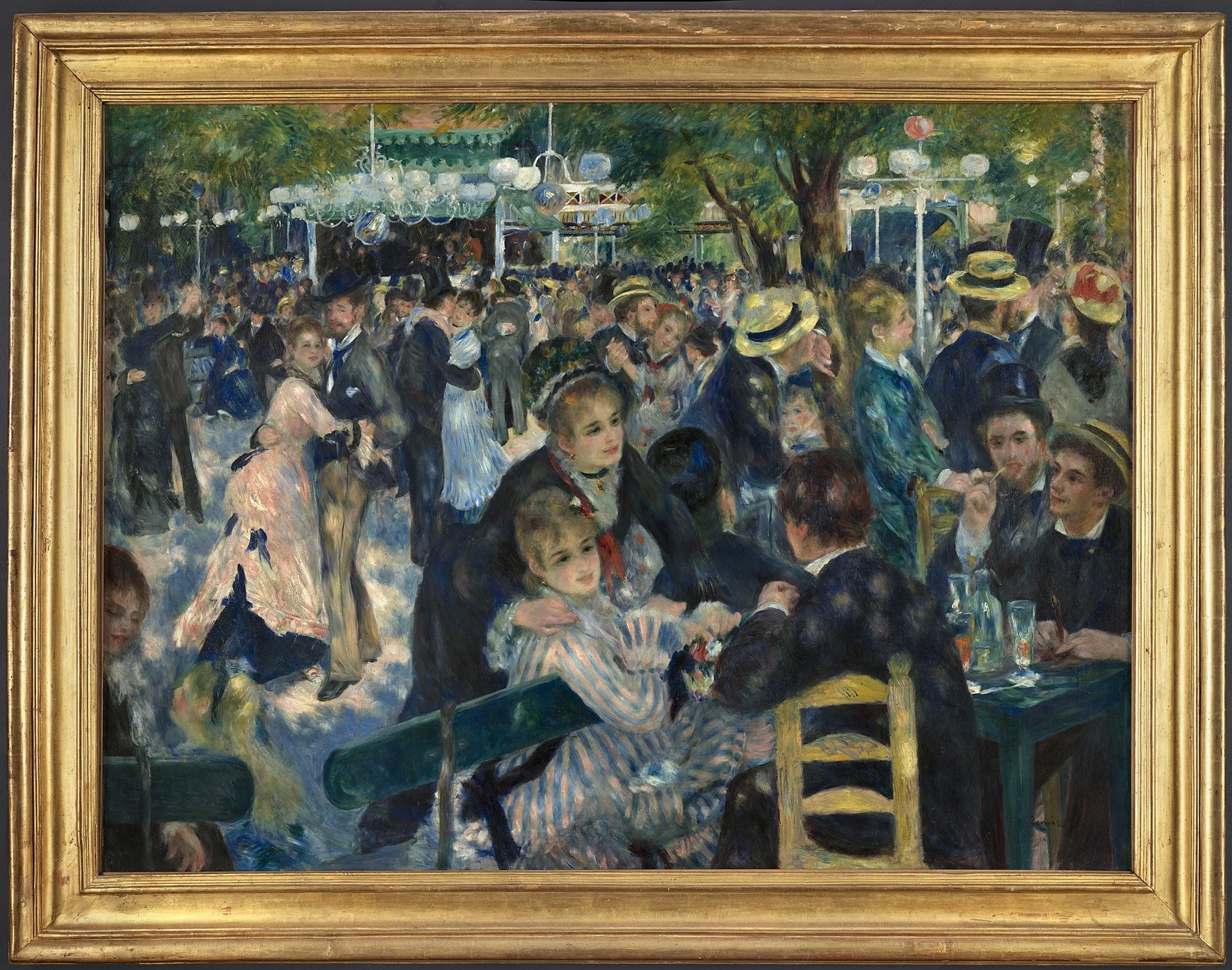
Credits: Pierre-Auguste Renoir, 'Dance at the Moulin de la Galette', 1876. Musée d'Orsay, Paris (RF 2739) Gustave Caillebotte Bequest, 1896. © photo Grand Palais RMN (Musée d'Orsay) / Mathieu Rabeau
The paintings invite us to recognise those gestures in our own lives. They suggest that beauty is not necessarily found in the extraordinary, but in the capacity to see the extraordinary within the everyday.
Renoir and Love is an exhibition about an artist at a pivotal point in his career, but it is also an invitation to reconsider the role of love in the way we see the world. Its beauty lies in the paintings themselves, in the care with which they have been assembled and in the narrative that emerges as we move through the rooms. Yet its lasting value may lie in something less tangible: the reminder that human connection deserves our attention.
Perhaps that is what the best exhibitions do. They do not simply present us with objects to admire. They change the way we see, even if only slightly, and send us back into the world with a renewed appreciation for what we might otherwise overlook. In Renoir’s paintings, love is present in a glance, a dance, a shared meal or the quiet closeness of a mother and child. These moments are fleeting, but they are not insignificant. They are the substance of our lives, and the connections through which we make sense of them.
At the National Gallery, Renoir reminds us that to look at another person with care is already a way of recognising their importance. In a world that often asks us to move faster, there is something quietly radical about stopping long enough to see.